Home-alone boredom busters for dogs: safe ways to keep them busy

Summary
Dogs need more than physical exercise to stay happy and fulfilled. Opportunities to sniff, chew, explore, problem-solve and play can provide valuable mental stimulation, particularly when they spend part of the day home alone.
The best home-alone activities are safe, suited to your individual dog and tested under supervision first. Food-dispensing toys, simple scent games, carefully chosen chew toys and a comfortable place to rest can all help make alone time more interesting.
However, destructive behaviour, barking or toileting while you are away isn’t always caused by boredom. If your dog becomes distressed when left alone, enrichment alone may not solve the problem and veterinary or behavioural advice may be needed.
Is your dog bored – or anxious about being alone?
A bored dog may look for their own entertainment by chewing inappropriate objects, digging, stealing items or barking. Increasing exercise, enrichment and opportunities to perform normal dog behaviours may help.
Separation-related anxiety is different. Dogs that are distressed when left alone may pace, pant, bark or howl persistently, destroy doors or windows, toilet indoors, attempt to escape or show other signs of distress. Some highly anxious dogs will not even eat a favourite food toy when their person leaves.
If your dog seems panicked rather than simply under-stimulated, speak to your veterinarian or a qualified reward-based behaviour professional rather than trying to solve the problem by adding more toys.
Read our article Tips to avoid and treat separation anxiety in dogs.
Expert advice from Dr Felicia:
Often dogs with severe separation anxiety will need medication to help them adjust and learn to be comfortable with being alone. Sometimes these medications can be weaned and the good work carried on with toys/treats that encourage chewing which is very satisfying and comforting for dogs.
Before you leave: set your dog up for success
Enrichment works best when your dog’s basic needs have already been met. Before leaving them alone:
- give them an opportunity to toilet
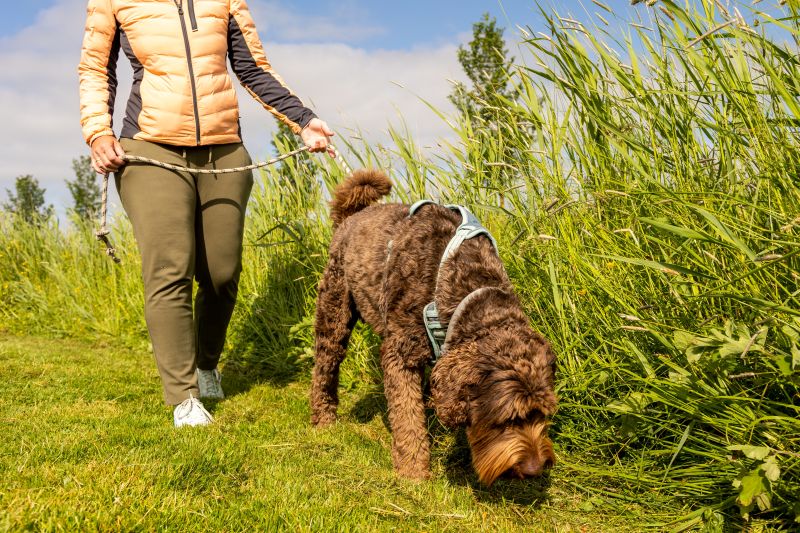
- provide suitable exercise, such as a walk with plenty of time to sniff
- make sure fresh water is always available
- leave them in a comfortable, secure and appropriately sized area
- remove household items they could chew, swallow or become tangled in
- choose only toys and enrichment you already know they can use safely.
A calm sniffing walk can be particularly useful because exploring scents provides mental as well as physical stimulation. Dogs vary considerably, however, so the aim is not necessarily to exhaust them before you leave but to help meet their individual physical and behavioural needs.
1. Turn breakfast into a boredom buster
For food-motivated dogs, using part or all of their normal meal as enrichment can provide a rewarding activity without adding lots of extra calories.
Try:
- a sturdy food-dispensing toy
- a slow feeder
- a snuffle mat, if your dog does not chew or ingest the fabric
- scattering kibble in a safe area for your dog to sniff out
- hiding small portions of food in easy-to-find locations around a dog-proof room.
Start with an easy challenge. If the puzzle is too difficult, your dog may simply become frustrated and give up.
Frozen food toys
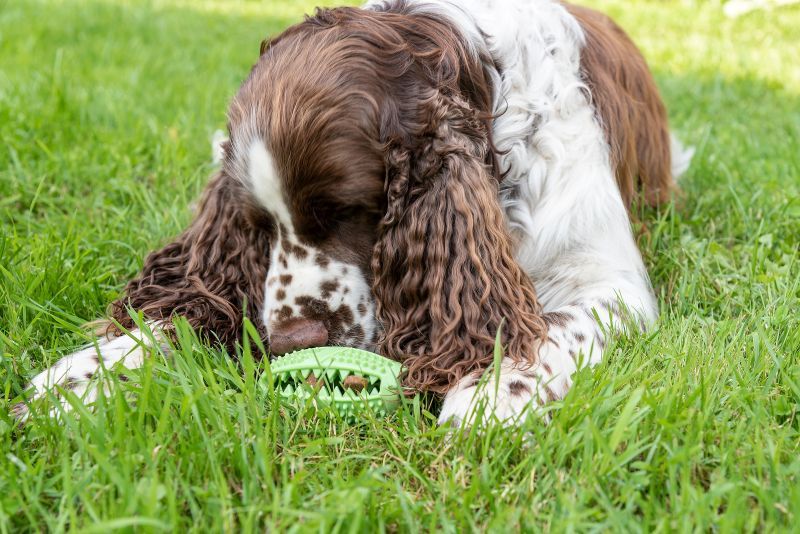
A durable hollow food toy can be filled with your dog’s normal wet food or softened kibble and chilled or frozen to make it last longer.
If you add foods such as plain yoghurt, banana or peanut butter, keep portions small and make sure all ingredients are suitable for your dog. Never use peanut butter containing xylitol, which is highly toxic to dogs.
Count food used for enrichment as part of your dog’s normal daily intake rather than adding it on top.
Expert advice from Dr Felicia:
This is actually a form of counter-conditioning where you can condition your dog to feel excitement at your departure, to help them learn to enjoy being alone.
2. Give them something safe to chew
Chewing is a normal canine behaviour and can be a useful way for some dogs to occupy themselves.
Choose a durable chew or toy that is appropriate for your dog’s size, chewing style and dental health. Before leaving any item with your dog unsupervised, watch them use it several times first.
Discard damaged toys and avoid anything that can splinter, break into swallowable pieces or become lodged in the mouth or throat. Dogs that tend to destroy and swallow toys may not be suitable candidates for unsupervised chew enrichment.
Expert advice from Dr Felicia:
Broken parts of rubber toys or stuffing, if swallowed can cause a gastrointestinal obstruction requiring endoscopy or surgery to remove from your dog’s stomach or intestine, so it pays to be careful especially with dogs that love to chew their toys into small bits.
3. Rotate their toys
Rather than leaving every toy available all the time, rotate a small selection. An old favourite can become interesting again after disappearing for a few days.
Choose toys according to what your dog actually enjoys. Some love squeakers, others prefer carrying soft toys, while food-motivated dogs may ignore everything except a treat dispenser.
Check toys regularly for torn fabric, exposed stuffing, loose squeakers or broken pieces before leaving your dog alone with them.
Expert advice from Dr Felicia:
Variety can go a long way to keeping a dog occupied. If your dog enjoys a variety of games or activities, try to mix it up! Or for high value games/items, only providing them when you’re not there can increase your dog’s enthusiasm/excitement.
4. Let them use their nose
Dogs experience much of their world through scent, so a simple “find it” activity can provide excellent mental stimulation.
Before leaving, hide a few pieces of your dog’s meal in safe, accessible locations around a dog-proof room or secure yard. Start with obvious locations and gradually make the search more interesting once your dog understands the game.
Avoid hiding food somewhere that encourages climbing on furniture, squeezing behind appliances or accessing areas you would normally keep off-limits.
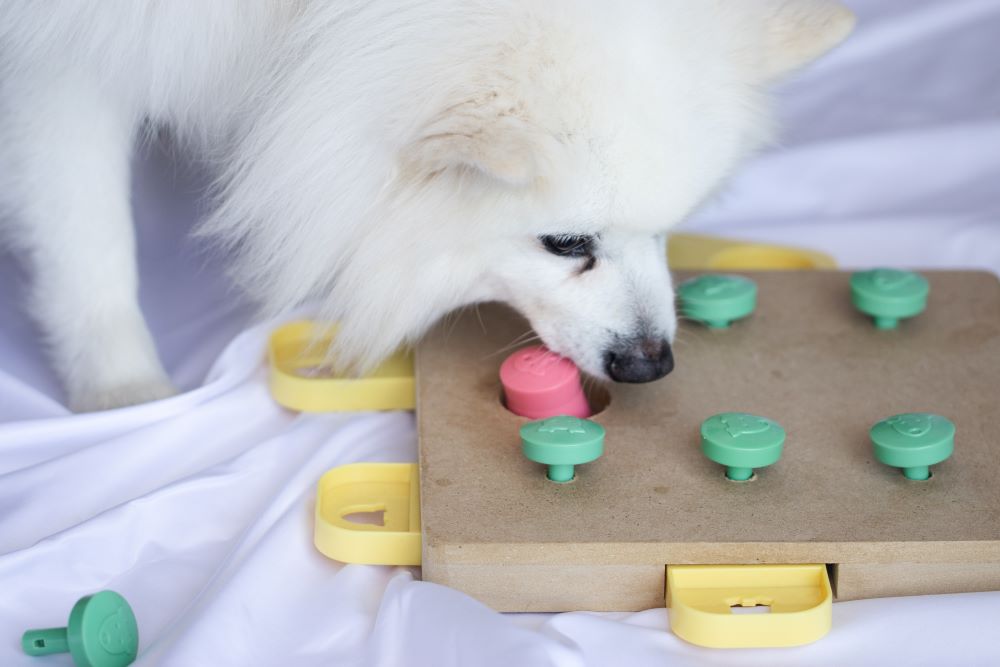
5. Puzzle toys: choose the right difficulty
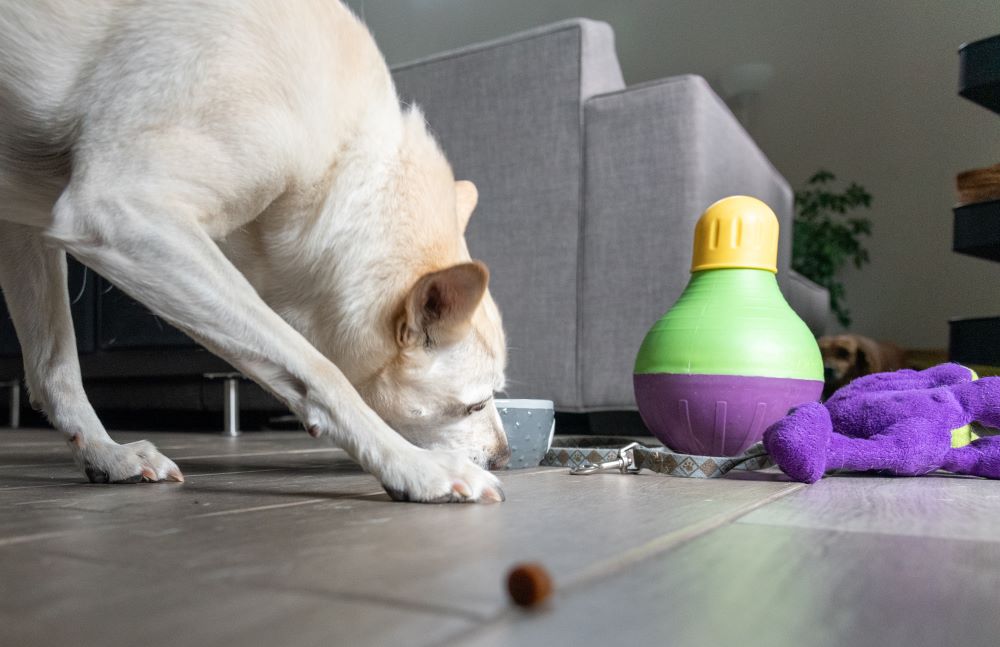
Puzzle feeders can encourage sniffing, pawing and problem-solving, but they need to suit your dog’s experience level.
Introduce a new puzzle while you are at home. Show your dog how it works and make the first attempts easy enough that they can succeed. Only leave it for unsupervised use once you are confident they will interact with it safely rather than chew or dismantle it.
Rotate puzzles rather than continually increasing the difficulty. Enrichment should be enjoyable, not an endurance test.
For more owner-led enrichment ideas, read our article Brain workout – Mental exercise for dogs.
6. Give your dog a comfortable place to switch off
Good home-alone enrichment also includes the opportunity to do nothing.
Adult dogs naturally spend a significant part of the day resting and sleeping. Provide at least one comfortable place where your dog can relax away from excessive noise, heat or cold.
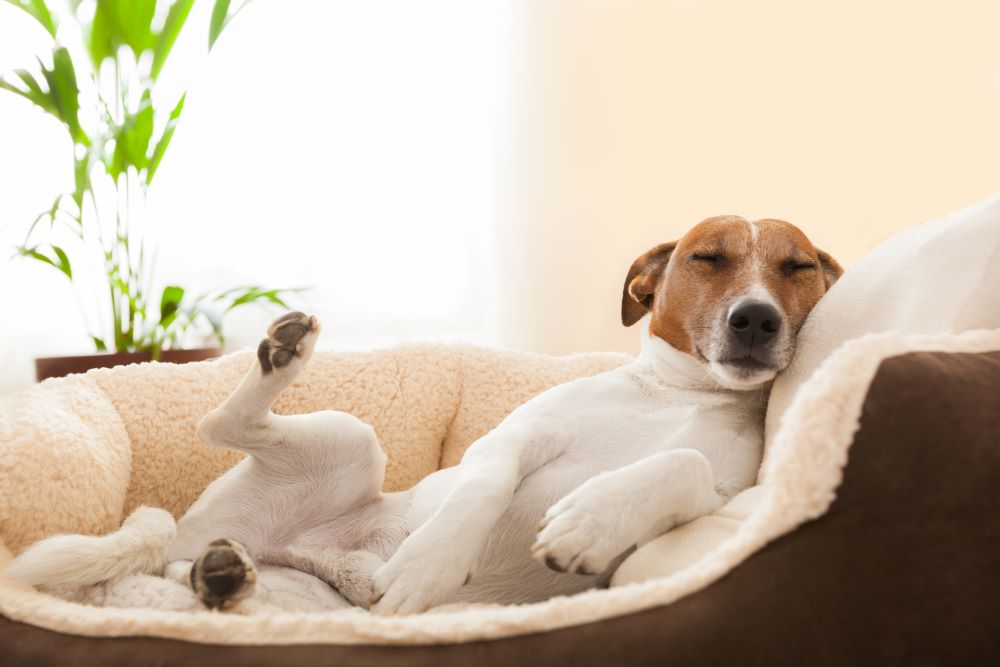
Some dogs enjoy a bed where they can watch the world through a window; others find passing people, dogs or traffic overstimulating and are calmer away from the view. Follow your own dog’s behaviour.
7. Does leaving music on help dogs?
Some dogs appear to relax with gentle background sound, while others prefer quiet.
Research in kennelled dogs has found changes associated with more relaxed behaviour when music is played, but responses vary and no single genre has been shown to work for every dog. One study found dogs spent more time lying down while several different genres were played, not just classical music.
If you want to try music, radio or another familiar background sound, keep the volume low and watch your dog’s response while you are home first.
Read our article Calming songs for anxious dogs.
Expert advice from Dr Felicia:
Playing music inside the house can also help remove noise distractions that may trigger your dog to bark, such a car sounds, delivery people, birds or even other dogs.
8. Break up a long day with company
No toy can replace social interaction indefinitely. If your dog regularly spends a long period alone, consider whether a trusted dog walker, pet sitter, family member or appropriate doggy day-care arrangement could provide a mid-day break.
How long an individual dog can comfortably be left alone depends on factors including age, health, toileting needs, temperament and how well they have been taught to cope with separation.
Read our article How long can you leave a dog or puppy alone?
Before leaving your dog alone with enrichment
- Test every activity while you are home first. Make sure your dog cannot swallow, dismantle, become tangled in or injure themselves on it.
- Choose toys large enough that they cannot be swallowed, remove damaged items, and remember that an activity that is safe for one dog may not be safe for another.
- If your dog is an intense chewer or routinely destroys and eats toys, food-dispensing enrichment may need to be used only while supervised.
Conclusion
The best home-alone boredom busters do not need to be complicated or expensive. A sniffing walk before you leave, part of breakfast served in a food toy, a safe chew, a comfortable place to sleep and a little variety from day to day may be all your dog needs.
Get to know what genuinely keeps your dog relaxed and engaged, and always test new enrichment while you are there to supervise. If your dog seems distressed rather than merely bored when left alone, seek advice rather than relying on toys to solve the problem.
And remember: enrichment can make alone time more enjoyable, but it cannot replace exercise, training, companionship and quality time with you.
Bow Wow Meow Pet Insurance can help protect you and your dog should an unexpected trip to the vet occur.
-
Find out more about our dog insurance options
-
Get an online pet insurance quote
Bow Wow Meow is proud to have been awarded winner of Canstar’s ‘Most Satisfied Customers’ Award in the Pet Insurance category for both 2024 and 2025!
Bow Wow Meow is proud to be the only Pet Insurer that has been awarded Product Review’s Top Rated Pet Insurance every year from 2018 to 2026! This is based on 3,193 independent customer reviews (as at 09/04/2026), with an overall rating of 4.5 stars.

We also have the following ratings on other review platforms:
Google Review rating of 4.5 stars (based on 1,358 reviews)
Trust Pilot rating of 4.6 stars (based on 555 reviews)
Bow Wow Meow has been chosen as Winner of 4 categories in the 2026 Finder Pet Insurance Customer Satisfaction Awards!
– Most Trusted Pet Insurance
– Easiest to Claim Pet Insurance
– Most Recommended Pet Insurance
– Legendary Service Pet Insurance
We also received Highly Commended Awards for Loved Brand Pet Insurance and Best Value Pet Insurance.
Bow Wow Meow is an Australian-owned and operated pet insurance provider. Our focus is purely on pets, and we are proud to have helped provide peace of mind to over 200,000 Aussie pet owners since 2008.
Sources:
“The importance of enrichment for dogs”, RSPCA Australia. https://www.rspca.org.au/latest-news/blog/the-importance-of-enrichment-for-dogs/. Accessed 22 September 2026.
“What can I do if my dog is anxious when I’m not at home?”, RSPCA Knowledgebase. https://kb.rspca.org.au/categories/companion-animals/dogs/behaviour/what-can-i-do-if-my-dog-is-anxious-when-im-not-at-home. Accessed 22 September 2026.
“Preparing your pet for the easing of COVID-19 restrictions”, RSPCA Australia. https://www.rspca.org.au/latest-news/blog/preparing-your-pet-easing-covid-19-restrictions/. Accessed 22 September 2026.
“My puppy is chewing everything, what should I do?”, RSPCA Knowledgebase. https://kb.rspca.org.au/categories/companion-animals/dogs/behaviour/my-puppy-is-chewing-everything-what-should-i-do. Accessed 22 September 2026.
Bowman A, et al. “‘The effect of different genres of music on the stress levels of kennelled dogs’”, Physiology & Behavior, 2017. https://pubmed.ncbi.nlm.nih.gov/28093218/. Accessed 22 September 2026.