Do cats dream? Why cats twitch in their sleep


Summary
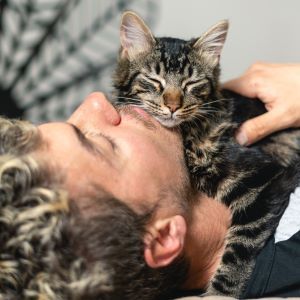
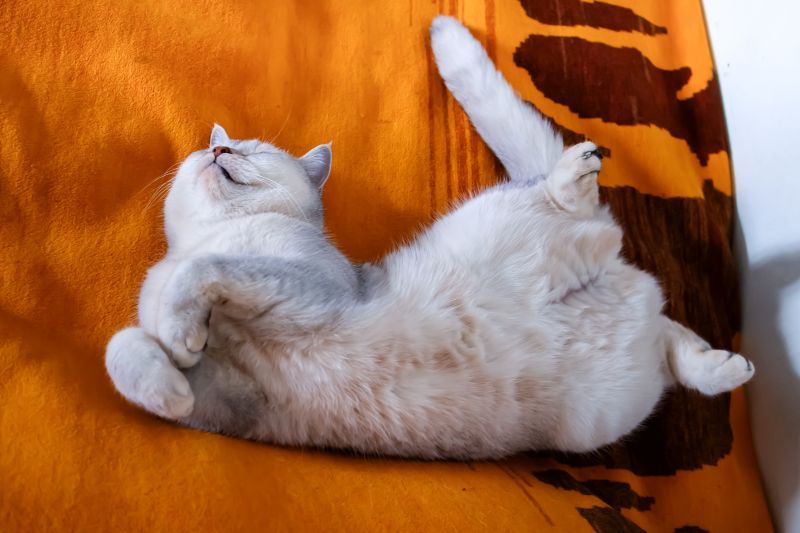
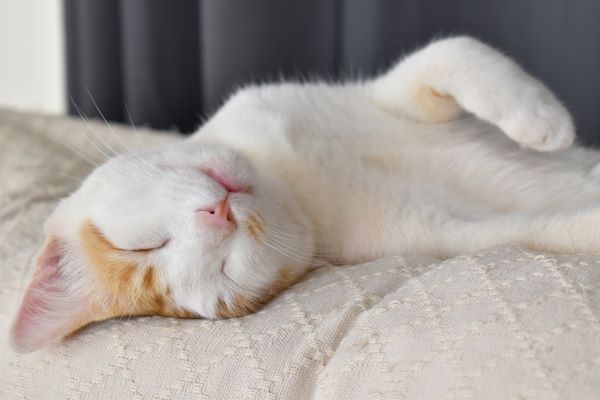
Cats spend a remarkable amount of time asleep, and anyone who has watched a snoozing cat may have noticed paws twitching, whiskers flicking, eyes moving beneath closed lids or even the occasional tiny meow.
So, are they dreaming? Cats experience rapid eye movement (REM) sleep and show many of the same physiological features associated with dreaming in humans, including an active brain, rapid eye movements and brief muscle twitches. We can’t ask a cat what was happening in their mind, however, so exactly what – or even how – cats experience dreams remains a fascinating mystery.
Do cats dream?
There is good evidence that cats experience REM sleep, the sleep stage strongly associated with vivid dreaming in humans.
During REM sleep, the brain is highly active, the eyes may move rapidly beneath the eyelids and most skeletal muscles become temporarily relaxed. At the same time, small twitches of the paws, face, ears or whiskers can occur. These characteristics have been documented extensively in sleeping cats.

This makes it reasonable to believe that cats probably experience something resembling dreams. However, scientists cannot directly determine a cat’s subjective experience, so it is more accurate to say that the evidence strongly suggests cats dream rather than that we know exactly what their dreams are like.
Expert advice from Dr Felicia:
Dreaming cats are in a deep sleep, so dreaming is more likely to happen both at nighttime, and when cats feel like they are resting in a place that is safe.
Why do cats twitch in their sleep?
While we can’t know for certain, those funny behaviours you may have noticed, such as twitching whiskers, paddling paws and flicking tails, all suggest the “acting out” of dream scenarios. Your cat may be reliving a playful chase, guarding their territory, or engaging in imaginary adventures. These dreams can trigger small twitches in their legs, tail, or whiskers as their brain mimics the movements of these imagined activities.
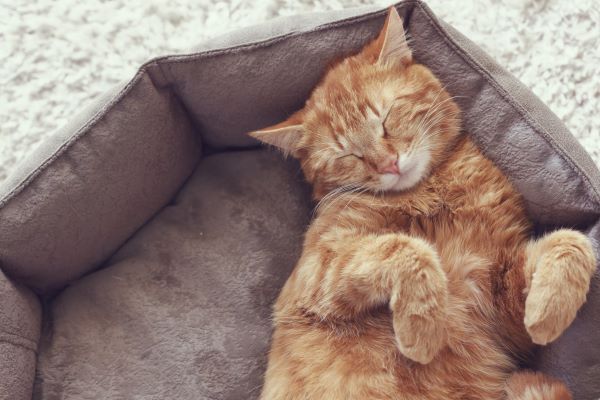
Cats make noises in their sleep for the same reason. Whimpers, soft meows, purrs and chirps can all be part of their dream experience, reflecting what’s happening in their dream world. .
Other amusing dream-state motions that you kitty may make include:
- Scrunching or wiggling their noses
- Small ear flicks, possibly responding to imaginary sounds
- Chewing or smacking their lips as if they are eating
- Eyes moving behind their eyelids
- Paddling their paws as if they are kneading dough
- Jerking or twitching their whole body as if they are startled or pouncing
What do cats dream about?
The short answer is: we don’t know. It is tempting to imagine that cats dream about the things that fill their waking lives – chasing toys, stalking birds, exploring the garden, eating dinner or curling up with their favourite person.
That is certainly possible, but science cannot currently tell us what images, memories or experiences a sleeping cat is actually having.
Research into feline REM sleep has shown patterns of brain activity and behaviour that are consistent with an active internal state, and experimental studies have produced complex movements during REM-like sleep. However, these findings do not allow researchers to translate those movements into specific dream content.
So your cat might be dreaming about that bird outside the window – but we can’t say for certain.
Did you know?
Cats played an important role in early sleep research. Studies of feline REM sleep helped scientists understand how the brain normally suppresses large body movements during REM while still allowing small muscle twitches.
Do cats have nightmares?
This is another question we cannot answer with certainty. Cats may twitch, vocalise, tense briefly or wake suddenly from sleep, but those behaviours alone do not prove they were experiencing a frightening dream.
Because cats cannot describe their experiences after waking, there is currently no reliable way to determine whether they have nightmares in the same subjective sense that people do.
If your cat wakes suddenly but quickly settles and behaves normally, there is usually no reason for concern. If episodes are unusually intense, frequent or accompanied by abnormal behaviour after waking, however, it is worth discussing them with your veterinarian.
Why do cats sleep so much?
Cats are champion sleepers. Adult cats commonly sleep around 12 to 16 hours in a 24-hour period, although the amount varies between individuals and can be influenced by age, activity, environment and health.
Rather than sleeping for one long uninterrupted period like many people do, cats tend to have numerous periods of sleep and rest throughout the day and night.
Their evolutionary history as predators helps explain this pattern. Cats are adapted for relatively short bursts of concentrated activity, such as stalking and chasing prey, interspersed with much longer periods of rest.
Cats are also generally described as crepuscular, meaning they often show peaks of activity around dawn and dusk rather than being truly nocturnal. Domestic cats can also adjust their activity patterns considerably around the routines of the people they live with.
Do cats only have REM sleep at night?
No. Cats cycle through different stages of sleep during sleep periods throughout the day and night.
Experimental recordings have found REM and non-REM sleep distributed across feline sleep periods, rather than REM being simply a night-time phenomenon.
What is the difference between REM and non-REM sleep in cats?
Like other mammals, cats move between different sleep states.
During non-REM sleep, brain activity becomes slower and the body is generally quiet and relaxed.
During REM sleep, brain activity becomes more activated, the eyes may move beneath the eyelids and muscle tone decreases significantly. Small twitches of the paws, whiskers and facial muscles are particularly characteristic of this stage.
This is why the little movements owners associate with “kitty dreams” are often most noticeable during REM sleep.
When is twitching during sleep normal?
Occasional, brief twitching while your cat is asleep is usually normal, particularly if your cat:
- remains otherwise relaxed
- has short, intermittent movements rather than continuous violent jerking
- wakes normally
- seems alert and behaves as usual afterwards.
There is generally no need to wake a peacefully sleeping cat because their paws or whiskers are twitching.
Expert advice from Dr Felicia:
Cats can develop tremors which can be associated with infections, nutritional deficiencies or other diseases. If the tremoring continues when your cat is awake, see your vet.
Could twitching during sleep be a seizure?
Sometimes abnormal neurological activity can occur while a cat is resting or around the time they fall asleep or wake up, and seizures can occasionally be mistaken for normal sleep movements.
Signs that warrant veterinary attention include:
- prolonged or forceful whole-body jerking
- marked muscle rigidity
- loss of consciousness or responsiveness
- excessive drooling
- urination or defecation during the episode
- unusual chewing, lip-smacking or repetitive facial movements
- confusion, pacing or abnormal behaviour afterwards
- similar episodes occurring while your cat is awake.
Generalised seizures may involve rigid limbs and repetitive paddling or running movements, and affected cats can remain confused or behave unusually afterwards.
If possible, take a video and time the episode to show your veterinarian. A seizure lasting around five minutes or longer, or repeated seizures without normal recovery between them, requires urgent veterinary care.

When should changes in your cat’s sleep concern you?
The number of hours a cat sleeps can vary considerably, so a change from your cat’s normal routine is often more useful than counting exact hours.
Speak to your veterinarian if your cat:
- suddenly sleeps much more or much less than usual
- is difficult to rouse for things that normally interest them
- seems lethargic or unusually sleepy when awake
- becomes increasingly restless at night
- shows repeated violent movements during sleep
- displays any other changes in appetite, behaviour, mobility or general health.
Changes in sleep patterns can sometimes accompany pain, illness or age-related conditions, particularly in older cats.
In summary
Cats experience REM sleep and show many of the brain and body changes associated with dreaming in humans, so there is good reason to believe they probably dream too.
Exactly what happens inside a sleeping cat’s mind remains unknown, however. Those twitching paws could accompany a dream about chasing something exciting – or they may simply reflect the normal neurological activity of REM sleep.
For most cats, a few whisker flicks, paw twitches and sleepy noises are nothing to worry about. So if your cat is comfortably snoozing and starts conducting an imaginary chase with their paws, enjoy the show – and let them sleep.
Bow Wow Meow Pet Insurance can help protect you and your cat should an unexpected trip to the vet occur.
-
Find out more about our cat insurance options
-
Get an online pet insurance quote
Bow Wow Meow is proud to have been awarded winner of Canstar’s ‘Most Satisfied Customers’ Award in the Pet Insurance category for both 2024 and 2025!
Bow Wow Meow is proud to be the only Pet Insurer that has been awarded Product Review’s Top Rated Pet Insurance every year from 2018 to 2026! This is based on 3,193 independent customer reviews (as at 09/04/2026), with an overall rating of 4.5 stars.

We also have the following ratings on other review platforms:
Google Review rating of 4.5 stars (based on 1,358 reviews)
Trust Pilot rating of 4.6 stars (based on 555 reviews)
Bow Wow Meow has been chosen as Winner of 4 categories in the 2026 Finder Pet Insurance Customer Satisfaction Awards!




– Most Trusted Pet Insurance
– Easiest to Claim Pet Insurance
– Most Recommended Pet Insurance
– Legendary Service Pet Insurance
We also received Highly Commended Awards for Loved Brand Pet Insurance and Best Value Pet Insurance.
Bow Wow Meow is an Australian-owned and operated pet insurance provider. Our focus is purely on pets, and we are proud to have helped provide peace of mind to over 200,000 Aussie pet owners since 2008.
Sources
Blumberg MS, Lesku JA, Libourel P-A, Schmidt MH, Rattenborg NC. “What is REM sleep?”, Current Biology, 2020. https://pmc.ncbi.nlm.nih.gov/articles/PMC6986372/. Accessed 17 September 2026.
Sastre JP, Jouvet M. “Relationship between eye movements and oneiric behavior in cats”, Physiology & Behaviour, 1979. https://pubmed.ncbi.nlm.nih.gov/1409919/. Accessed 17 September 2026.
Morrison AR. “Mechanisms underlying oneiric behaviour released in REM sleep by pontine lesions in cats”, Journal of Sleep Research, 1993. https://pubmed.ncbi.nlm.nih.gov/10607062/. Accessed 17 September 2026.
Tobler I, Borbély AA. “Sleep and EEG slow-wave activity in the domestic cat: effect of sleep deprivation”, Behavioural Brain Research, 1990. https://pubmed.ncbi.nlm.nih.gov/2322413/. Accessed 17 September 2026.
“Is your pet sleeping too much?”, VCA Animal Hospitals. https://vcahospitals.com/resources/behavior-cat/concerns/is-your-pet-sleeping-too-much. Accessed 17 September 2026.
“True or False: Cats are nocturnal”, VCA Animal Hospitals. https://vcahospitals.com/resources/behavior-cat/true-or-false-cats-are-nocturnal. Accessed 17 September 2026.
“Seizures and Epilepsy in Cats”, VCA Animal Hospitals. https://vcahospitals.com/know-your-pet/seizures-and-epilepsy-in-cats. Accessed 17 September 2026.