How to give CPR to a dog or cat

If your pet is unresponsive and is not breathing normally, start CPR immediately. Ask someone to call the nearest emergency vet, or use your phone on speaker while you help.
Summary
Cardiopulmonary resuscitation (CPR) combines chest compressions to circulate blood with rescue breaths to supply oxygen. It may help keep a dog or cat alive while emergency veterinary treatment is arranged.
CPR is for an unresponsive pet that is not breathing normally. A conscious pet, or one breathing normally, should not receive chest compressions.
Knowing what to do before an emergency can help you respond more quickly. This guide explains the basic steps for dogs and cats.
How can I tell whether my pet needs CPR?
Check that it is safe to approach. Call your pet’s name and gently touch them, then quickly look for regular breathing.

Start CPR if your pet does not respond and is not breathing normally. Occasional gasps are not normal breathing.
Do not delay compressions while trying to find a pulse. Pulse checks can be difficult and unreliable, particularly during an emergency.
If your pet is unresponsive but breathing normally, seek emergency veterinary care immediately.
How to give CPR to your dog or cat
1. Call for help and start promptly
Ask a helper to telephone the nearest open veterinary hospital and arrange transport while you begin CPR.
If you are alone, use your phone on speaker where possible. Aim to start compressions within 10 seconds of recognising that your pet is unresponsive and not breathing normally. Start with compressions rather than spending time checking the mouth or giving breaths first.
2. Position your pet
Place your pet on their side on a firm, flat surface. Keep their head and neck aligned with their spine.
Kneel beside their back so you can compress the chest from above.
3. Position your hands
Place your pet on their side on a firm, flat surface. Keep their head and neck aligned with their spine.
Kneel beside their back so you can compress the chest from above.
3. Position your hands
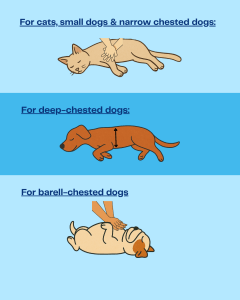
Hand placement depends on your pet’s size and chest shape.
| Pet’s size or chest shape | Where to compress |
|---|---|
| Medium or large dog with a rounded chest | Over the widest part of the chest, using the heel of one hand with your other hand on top. |
| Medium or large dog with a narrow, deep chest | Directly over the heart, approximately behind the elbow, using one hand over the other. |
| Cat or small dog | Over the heart, using one hand wrapped around the chest, with the thumb on one side and flat fingers on the other. Compress between your thumb and fingers. |
For larger dogs, keep your arms straight and your shoulders above your hands.
Begin with your pet on their side. Do not spend time repeatedly repositioning a broad-chested dog onto their back; follow the emergency vet’s instructions if they advise a different position.
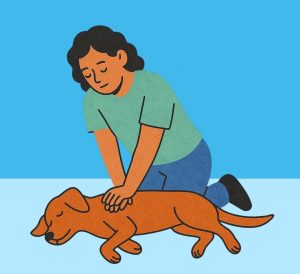
4. Give 30 chest compressions
Compress the chest at 100–120 compressions per minute.
With your pet lying on their side, compress approximately one-third to one-half of the chest’s width. Allow the chest to return fully to its normal shape after each compression.
Keep a steady rhythm and avoid leaning on the chest between compressions.
5. Give two rescue breaths
After 30 compressions:
- Keep the head and neck aligned with the spine.
- Gently hold your pet’s mouth closed.
- Seal your lips around their nose.
- Give one breath over about one second, using only enough air to make the chest visibly rise.
- Allow the chest to fall, then give a second breath.
Use smaller breaths for cats and small dogs. Resume compressions immediately after the two breaths.
If giving mouth-to-nose breaths would put you at risk, continue chest compressions without breaths.
6. Repeat and arrange emergency veterinary care
Continue cycles of 30 compressions followed by two breaths, keeping interruptions as short as possible.
If another person can help, swap the person giving compressions approximately every two minutes, with minimal interruption.
Briefly reassess for a response and normal breathing about every two minutes. Do not repeatedly pause for lengthy pulse checks.
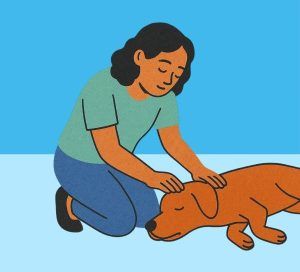
Arrange transport to the nearest open veterinary hospital promptly. CPR during travel should only be attempted if another person is driving and the rescuer can remain safely restrained. This may be possible with a small pet but is often impractical with a large dog. Never attempt CPR while driving.
When should I stop CPR?
Stop compressions if your pet begins responding or breathing normally, and follow the emergency vet’s instructions.
Otherwise, continue until veterinary staff take over, you are physically unable to continue or the situation becomes unsafe. There is no single home CPR time limit that applies to every pet.
Your pet still needs immediate veterinary care even if they appear to recover. CPR does not treat the underlying cause of the emergency.
When should I stop CPR?
Stop compressions if your pet begins responding or breathing normally, and follow the emergency vet’s instructions.
Otherwise, continue until veterinary staff take over, you are physically unable to continue or the situation becomes unsafe. There is no single home CPR time limit that applies to every pet.
Your pet still needs immediate veterinary care even if they appear to recover. CPR does not treat the underlying cause of the emergency. Veterinary Partner
How can I prepare for a pet emergency?
Save the telephone number and address of your nearest emergency veterinary hospital, including an after-hours option.
Consider completing a pet CPR course with practical instruction. RECOVER offers training specifically for pet owners and pet professionals. Practise compressions on a training manikin rather than a healthy pet.
Bow Wow Meow Pet Insurance can help protect you and your pet should an unexpected trip to your vet occur.
- Find out more about our dog insurance options
- Find out more about our cat insurance options
- Get an instant online pet insurance quote
Bow Wow Meow is proud to have been awarded winner of Canstar’s ‘Most Satisfied Customers’ Award in the Pet Insurance category for both 2024 and 2025!
Bow Wow Meow is proud to be the only Pet Insurer that has been awarded Product Review’s Top Rated Pet Insurance every year from 2018 to 2026! This is based on 3,193 independent customer reviews (as at 09/04/2026), with an overall rating of 4.5 stars.

We also have the following ratings on other review platforms:
Google Review rating of 4.5 stars (based on 1,358 reviews)
Trust Pilot rating of 4.6 stars (based on 555 reviews)
Bow Wow Meow has been chosen as Winner of 4 categories in the 2026 Finder Pet Insurance Customer Satisfaction Awards!




– Most Trusted Pet Insurance
– Easiest to Claim Pet Insurance
– Most Recommended Pet Insurance
– Legendary Service Pet Insurance
We also received Highly Commended Awards for Loved Brand Pet Insurance and Best Value Pet Insurance.
Bow Wow Meow is an Australian-owned and operated pet insurance provider. Our focus is purely on pets, and we are proud to have helped provide peace of mind to over 200,000 Aussie pet owners since 2008.
Sources:
“How to Perform CPR on a Cat”, American Red Cross. https://www.redcross.org/take-a-class/resources/learn-pet-first-aid/cat/cpr. Accessed 22 October 2026.
“CPR Guidelines for Dogs or Cats”, Virginia Tech Veterinary Teaching Hospital, published 21 April 2026. https://vth.vetmed.vt.edu/animal-care-tips/cpr-guidelines.html. Accessed 22 October 2026.
“RECOVER Guidelines: First Aid for Dogs and Cats. Clinical Guidelines”, Journal of Veterinary Emergency and Critical Care, published 25 August 2026. https://onlinelibrary.wiley.com/doi/10.1111/vec.70138. Accessed 22 October 2026.
“2024 RECOVER Guidelines: Updated treatment recommendations for CPR in dogs and cats”, Journal of Veterinary Emergency and Critical Care, 2024. https://onlinelibrary.wiley.com/doi/10.1111/vec.13391. Accessed 22 October 2026.
“2024 RECOVER Guidelines: Basic Life Support. Evidence and knowledge gap analysis with treatment recommendations for small animal CPR”, Journal of Veterinary Emergency and Critical Care, 2024. https://onlinelibrary.wiley.com/doi/10.1111/vec.13387. Accessed 22 October 2026.
“2024 RECOVER Guidelines: Monitoring. Evidence and knowledge gap analysis with treatment recommendations for small animal CPR”, Journal of Veterinary Emergency and Critical Care, 2024. https://onlinelibrary.wiley.com/doi/10.1111/vec.13390. Accessed 22 October 2026.
“Cardiopulmonary Resuscitation (CPR): First Aid”, Veterinary Partner, Veterinary Information Network. https://veterinarypartner.vin.com/default.aspx?pid=19239&id=4951315. Accessed 22 October 2026.
“CPR Course for Pet Owners and Pet Professionals”, RECOVER Initiative. https://recoverinitiative.org/pet-owners-and-pet-professionals/cpr-course-for-pet-owners-and-pet-professionals/. Accessed 22 October 2026.
“Discover our Nose-to-Tail Cover”, Bow Wow Meow Pet Insurance. https://bowwowinsurance.com.au/cover-options/. Accessed 22 October 2026.