Why does my cat keep meowing?
Summary
Cats meow for many reasons, from asking for food or attention to responding to changes in their environment. Some cats are naturally more vocal than others, and the meaning of a meow depends on its context, your cat’s body language and what is normal for them.
However, a sudden increase in meowing or yowling can sometimes indicate stress, pain or illness—particularly in an older cat. If your cat’s vocalisation has changed noticeably or is accompanied by other symptoms, arrange a veterinary check-up.
Why do cats meow?
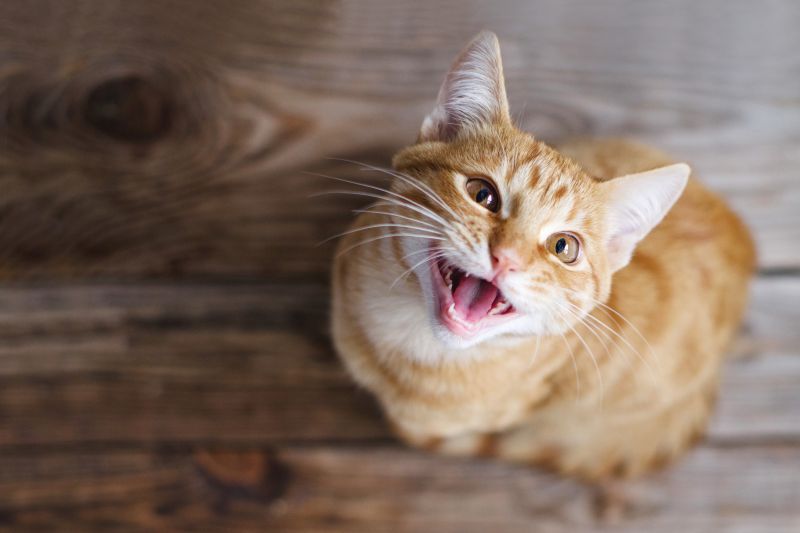
We tend to think of cats as calm and quiet creatures, especially compared to boisterous, barking dogs. But, as many cat owners will attest, felines can also be extremely vocal: meowing you awake at 5 am, demanding their dinner at mealtime, ‘talking’ to you while you’re working, or soliloquising at midnight.
Vocalising is a normal part of feline communication, but there is no single meaning behind every sound. Cats may meow to seek attention, ask for food, greet you, request access to something or express discomfort, and the meaning often depends on the situation, their body language and what is normal for that individual cat.
If a usually quiet cat suddenly becomes much more vocal, or their meowing changes in tone, frequency or intensity, it is worth paying attention. Increased or unusual vocalisation can sometimes be associated with stress, pain or illness, while other meows may simply be part of normal social interaction or play.

Common reasons why cats meow
Adult cats use meowing particularly often when interacting with people. Over time, individual cats and their owners may develop familiar patterns of vocal communication, with cats learning which sounds tend to get a response. Some cats are naturally more vocal than others, and breeds such as the Siamese are particularly well known for their “conversations” with people.
1. They want food, access or something else
Cats may meow to signal their needs, such as wanting access to another room, alerting you to an empty food bowl, or even expressing dissatisfaction with a change in routine.
Cats may become particularly vocal around feeding time. Some even use a distinctive “solicitation purr”, combining purring with a higher-frequency element that people can find difficult to ignore.
However, a noticeable increase in hunger accompanied by weight loss, restlessness, increased thirst or other changes warrants veterinary attention, particularly in an older cat.
Did you know?
Research suggests that people are better at interpreting the vocalisations of cats they know than unfamiliar cats, although even experienced cat owners cannot reliably translate every meow into a specific message.
2. They want attention or social interaction
Cats may have a reputation for independence, but they are also social animals that form strong bonds with their humans.
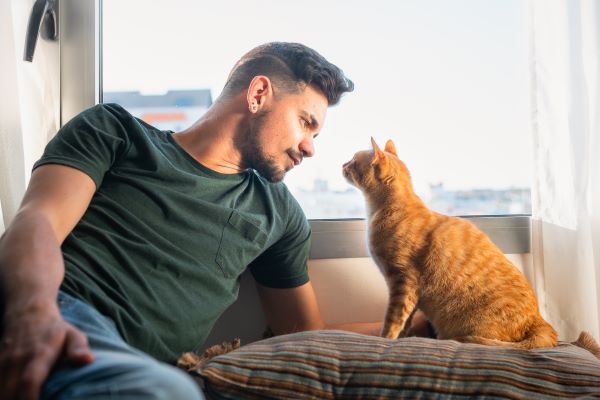
Some cats enjoy verbal exchanges, responding to their owners’ voices with meows of their own. Others may meow as a way of reminding you to engage with them, such as through petting, playing, or simply being near them.
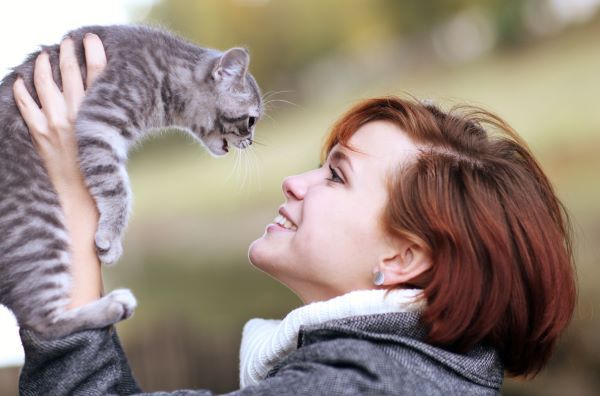
If attention-seeking meowing becomes excessive, providing regular play sessions and mental stimulation can help reduce it.
Did you know?
Research suggests cats can recognise when their own person is using their special “cat voice”. In one study, cats responded differently to speech directed specifically at them versus ordinary human-directed speech when it came from their owner, but not from a stranger.
3. They’re stressed, uncomfortable or unwell
Meowing can also signal discomfort or illness. If the vocalisations become more urgent or prolonged, or are accompanied by lethargy, vomiting, or appetite changes, it may indicate issues like hyperthyroidism, dental disease, arthritis and lower urinary tract disease.
A cat crying or vocalising while repeatedly visiting the litter tray, straining to urinate or passing little or no urine needs prompt veterinary assessment. An inability to pass urine is an emergency, particularly in male cats. If you’re concerned about any symptoms, check out our guide how to tell if your cat is sick.
4. They are looking for a mate
Cats that have not been desexed may become much more vocal when sexually mature. Female cats in season can produce persistent calling or yowling, while entire males may vocalise in response to females or competing cats nearby.
How to understand a cat’s meow
To better understand your cat, it’s essential to distinguish between different types of meows. Observing tone, frequency, context, and body language helps accurately interpret what your cat is trying to communicate. Here’s what you need to know to recognise their different meows.
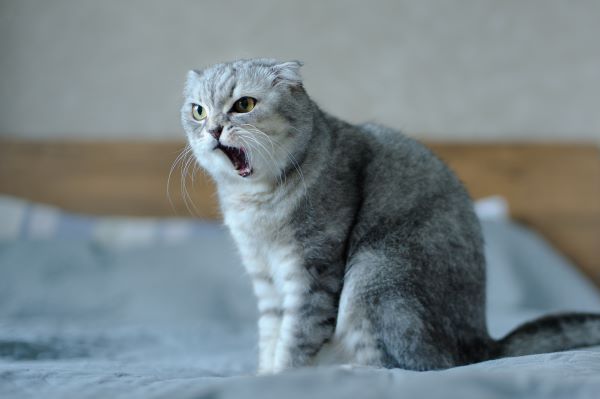
Tone and frequency
The pitch, volume, length and repetition of a meow can provide clues, but they do not have fixed meanings. A change from your cat’s usual vocal pattern may be more informative than any single type of meow. Consider the sound together with your cat’s body language, the situation and what is normal for them.
Examples of cat vocalisations and what they may mean
| Vocalisation | What it sounds like | May be associated with |
| Short meow or ‘meep’ | Brief, often light in tone | Greeting, attention or anticipation |
| Repeated meows | Several vocalisations close together | Excitement, requesting something or frustration |
| Long meow | Drawn-out vocalisation | A persistent request, protest or heightened arousal |
| Chirp or trill | Short, rolling or warbling sound | Friendly social interaction, greeting or excitement |
| Yowl | Long, loud, often intense | Mating behaviour, distress, conflict, disorientation or pain |
| Sudden shriek | Very loud and sharp | Fear, pain or intense conflict |
| Increased night-time vocalisation | Calling or yowling after dark | Social needs, environmental triggers or, particularly in older cats, medical or cognitive causes |
Context and environment
The context in which your cat meows plays a key role in interpreting their behaviour. Here are some typical examples:
- Cats often meow around feeding time or near their food bowl, signalling hunger.
- If your cat meows near a door, they might want to go in or out.
- If your cat meows beside you while you’re working, they may be seeking attention, play or access to something—or they may simply have learned that meowing gets a response.
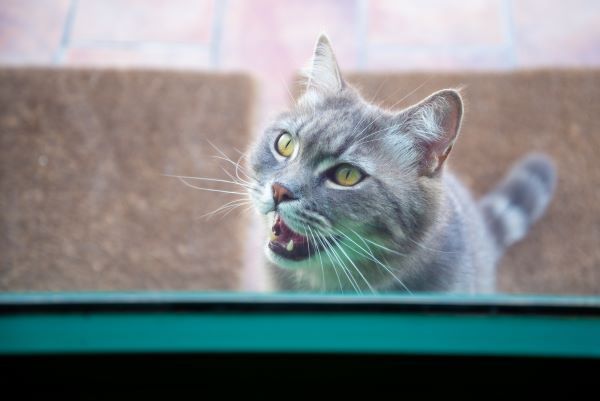
Changes in their environment such as new people, pets, or shifts in routine can also lead to increased meowing as they adjust to new stimuli.
Body language
Cats often combine vocalisations with visual signals, so look at their posture, ears, eyes and tail as well as listening to the meow. An upright tail, forward-facing ears and relaxed posture often accompany a friendly or confident interaction, while tense posture, flattened ears, a twitching tail or puffed-up fur can indicate heightened arousal, stress or discomfort.
For more clues, see our guide to cat tail signs.
Why does my cat meow at night?
Cats often have periods of increased activity around dawn and dusk, and some may meow at night because they are hungry, seeking interaction, responding to something outside or simply following their usual activity pattern.
However, new or persistent night-time vocalisation deserves closer attention, particularly in an older cat. Pain, hyperthyroidism, hypertension, hearing or vision changes and cognitive dysfunction can all contribute to increased calling or yowling at night. If this is a new behaviour for your cat, arrange a veterinary check-up rather than assuming it is simply behavioural.
How to reduce excessive meowing
The aim is not to stop a cat from communicating, but to work out why they are vocalising and address the underlying need or trigger.
Once medical causes and your cat’s basic needs have been considered, the following strategies may help reduce excessive vocalisation.
Provide regular feeding times
One common reason for meowing, especially around certain times of the day, is hunger. Cats tend to vocalise when they’re hungry, and keeping a consistent feeding schedule can help prevent excessive meowing.
If your cat constantly seems hungry despite receiving an appropriate amount of food, particularly if they are also losing weight or drinking more, speak to your vet rather than simply increasing their food.
Ensure adequate play and stimulation
Some cats may vocalise more when seeking interaction or when under-stimulated. Providing enough mental stimulation, such as interactive toys for cats, climbing trees, or puzzle feeders, can keep your cat entertained and reduce unnecessary meowing.
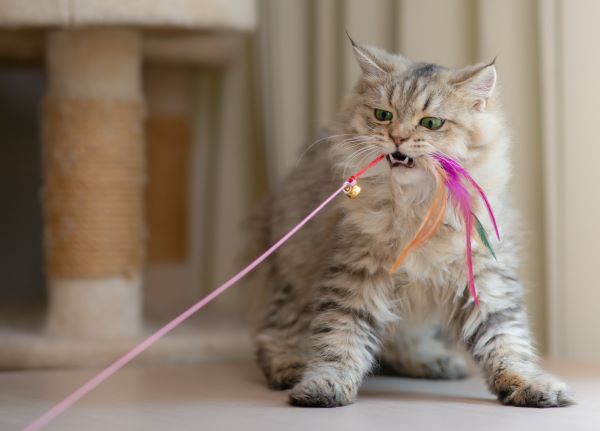
An interactive play session in the evening, followed by a small meal where appropriate, may help some cats settle into the household night-time routine.
Create a calm night-time environment
Cats often have periods of increased activity around dawn and dusk, and their sleep–wake pattern can also adapt to household routines.
Keep your cat’s evening routine predictable and make sure they have easy access to water, litter trays, comfortable sleeping areas and other essential resources. Provide daytime enrichment and interactive play, and consider a timed feeder if early-morning food demands are contributing to the problem.
If night-time vocalisation is new, persistent or occurring in an older cat, arrange a veterinary examination before assuming it is behavioural.
Avoid accidentally rewarding demand meowing
First make sure your cat’s physical, medical and environmental needs have been met. Never ignore vocalisation that is new, unusual or could indicate pain, fear or illness.
If your cat is healthy and you are confident they have learned to meow persistently for a particular reward—such as treats or attention—avoid giving that reward while they are actively demanding it. Instead, provide attention or rewards during calm, quiet behaviour.
Do not shout at, spray or punish your cat for vocalising. Punishment can increase fear or stress without addressing the reason for the behaviour.
When should you see a vet about excessive meowing?
Arrange a veterinary check if your cat’s meowing or yowling is new, noticeably more frequent than usual or accompanied by other changes such as:
- reduced or increased appetite
- weight loss
- increased thirst or urination
- vomiting or diarrhoea
- difficulty using the litter tray
- limping or reluctance to jump
- hiding or unusual aggression
- restlessness, confusion or disrupted sleep
- changes in hearing or vision
Seek urgent veterinary care if your cat is crying in pain, struggling to breathe, has collapsed, appears severely distressed or is repeatedly straining to urinate without producing urine.
Increased vocalisation in an older cat deserves particular attention because conditions including hyperthyroidism, hypertension, pain and cognitive dysfunction become more common with age.
Understanding your cat’s individual voice
Every cat has their own vocal habits, and over time you are likely to become familiar with the sounds they use in different situations. Rather than trying to translate each meow in isolation, consider the sound alongside your cat’s body language, environment and normal routine.
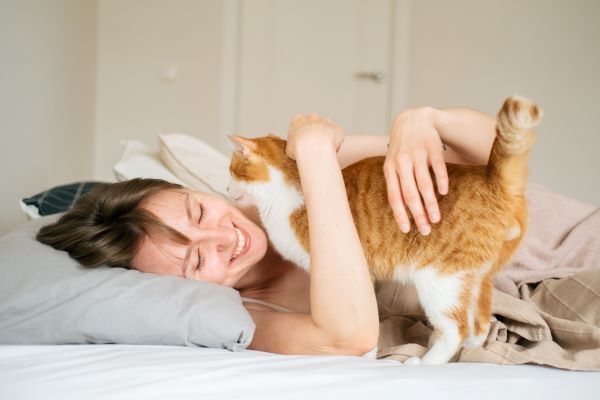
Learning what is normal for your cat not only strengthens your communication—it also makes it easier to notice when something has changed and may warrant closer attention.
The golden rule: Don’t interpret the meow alone. Look at the sound + body language + context + what’s normal for your cat.
Bow Wow Meow Pet Insurance can help protect you and your cat should an unexpected trip to the vet occur.
-
Find out more about our cat insurance options
-
Get an online pet insurance quote
Bow Wow Meow is proud to have been awarded winner of Canstar’s ‘Most Satisfied Customers’ Award in the Pet Insurance category for both 2024 and 2025!
Bow Wow Meow is proud to be the only Pet Insurer that has been awarded Product Review’s Top Rated Pet Insurance every year from 2018 to 2026! This is based on 3,193 independent customer reviews (as at 09/04/2026), with an overall rating of 4.5 stars.

We also have the following ratings on other review platforms:
Google Review rating of 4.5 stars (based on 1,358 reviews)
Trust Pilot rating of 4.6 stars (based on 555 reviews)
Bow Wow Meow has been chosen as Winner of 4 categories in the 2026 Finder Pet Insurance Customer Satisfaction Awards!




– Most Trusted Pet Insurance
– Easiest to Claim Pet Insurance
– Most Recommended Pet Insurance
– Legendary Service Pet Insurance
We also received Highly Commended Awards for Loved Brand Pet Insurance and Best Value Pet Insurance.
Bow Wow Meow is an Australian-owned and operated pet insurance provider. Our focus is purely on pets, and we are proud to have helped provide peace of mind to over 200,000 Aussie pet owners since 2008.
Sources
Prato-Previde E, et al. “What’s in a Meow? A Study on Human Classification and Interpretation of Domestic Cat Vocalizations”, Animals, 2020. https://pmc.ncbi.nlm.nih.gov/articles/PMC7765146/. Accessed 10 September 2026.
Schötz S, van de Weijer J, Eklund R. “Context effects on duration, fundamental frequency, and intonation in human-directed domestic cat meows”, Applied Animal Behaviour Science, 2024. https://www.sciencedirect.com/science/article/pii/S0168159123003180. Accessed 10 September 2026.
de Mouzon C, Gilbert C, Di-Stasi R, Leboucher G. “How’s my kitty? Acoustic parameters of cat-directed speech in human-cat interactions”, Behavioural Processes, 2022. https://pubmed.ncbi.nlm.nih.gov/36191757/. Accessed 10 September 2026.
de Mouzon C, et al. “Discrimination of cat-directed speech from human-directed speech in a population of indoor companion cats”, Animal Cognition, 2022. https://pubmed.ncbi.nlm.nih.gov/36280656/. Accessed 10 September 2026.
“Cognitive Dysfunction”, Cornell Feline Health Center, Cornell University College of Veterinary Medicine. https://www.vet.cornell.edu/departments-centers-and-institutes/cornell-feline-health-center/health-information/feline-health-topics/cognitive-dysfunction. Accessed 10 September 2026.
“Hyperthyroidism in Cats”, Cornell Feline Health Center, Cornell University College of Veterinary Medicine. https://www.vet.cornell.edu/departments-centers-and-institutes/cornell-feline-health-center/health-information/feline-health-topics/hyperthyroidism-cats. Accessed 10 September 2026.
“The Special Needs of the Senior Cat”, Cornell Feline Health Center, Cornell University College of Veterinary Medicine. https://www.vet.cornell.edu/departments-centers-and-institutes/cornell-feline-health-center/health-information/feline-health-topics/special-needs-senior-cat. Accessed 10 September 2026.
“Behavior Problems of Cats”, MSD Veterinary Manual. https://www.msdvetmanual.com/behavior/behavior-of-cats/behavior-problems-of-cats. Accessed 10 September 2026.
“AAFP/ISFM Environmental Needs Guidelines”, Feline Veterinary Medical Association. https://catvets.com/resource/aafp-isfm-environmental-needs-guidelines/. Accessed 10 September 2026.
McComb K, Taylor AM, Wilson C, Charlton BD. “The cry embedded within the purr”, Current Biology, 2009;19(13):R507–R508. https://pubmed.ncbi.nlm.nih.gov/19602409/. Accessed 10 September 2026.