How clever is your cat? What science says about feline intelligence


Are you constantly amazed by your cat’s apparent genius? Perhaps they seem to know exactly when dinner is due, solve food puzzles in seconds, recognise their name or somehow appear the moment you open the cupboard containing their treats.
Cats can be remarkably clever, but measuring feline intelligence isn’t straightforward. Unlike people, cats can’t take an IQ test – and unlike many dogs, they may not be particularly motivated to perform a task simply because a human asks them to.
Researchers therefore study specific cognitive abilities, such as learning, memory, problem-solving and the way cats respond to human voices, gestures and emotions.
And the more scientists look, the more interesting the feline mind becomes.
Expert advice from Dr Felicia:
When considering cat intelligence, it is important to remember it is much harder to reliably count on a cat’s motivation to work with you, compared with man’s best friend.
Cats vs dogs: which species is smarter?
Dogs are trained for jobs ranging from search and rescue to assistance work, detection and policing, while cats generally aren’t. But this doesn’t mean dogs are simply “smarter”.
Cats and dogs have different evolutionary histories and have been selected by humans for different traits. Dogs have undergone extensive selection for cooperation and working alongside people, while cats have retained much more of the independent hunting behaviour of their wild ancestors.
That can make comparing the intelligence of the two species rather like comparing different types of skill.
In experiments, cats have demonstrated an impressive ability to use information provided by humans. Studies have found that cats can follow human pointing gestures to locate hidden food, and recent research has replicated this ability in rescue cats.
Cats can also recognise familiar human voices, distinguish their own name from other words and use information from their owners when assessing unfamiliar situations.
So rather than asking whether cats are “smarter” than dogs, a better question is: what kinds of things are cats good at learning and understanding?

What can clever cats can do?
Research into feline cognition is still much smaller than the equivalent body of research on dogs, but scientists have uncovered some fascinating abilities.
Cats may be able to:
- Recognise their own name. Research has shown that domestic cats can distinguish their own names from other similar-sounding words, although recognising the sound does not necessarily mean they understand “this word means me”.
- Recognise familiar voices. Cats can distinguish their owner’s voice from those of unfamiliar people.
- Learn the names of familiar companions. Household cats have shown evidence of associating the names of other cats they live with with those cats’ faces.
- Follow human pointing gestures. Experimental studies have found that cats can use human pointing to help locate hidden food.
- Read some human emotional cues. Cats can use information from an owner’s facial expression and voice when deciding how to respond to something unfamiliar.
- Keep track of where their owner is. In one experiment, cats appeared surprised when their owner’s voice suddenly seemed to come from an unexpected location, suggesting they had formed a mental representation of where that person was.
- Learn associations quickly. A 2024 study found evidence that cats could rapidly associate particular spoken sounds with images after only brief exposure.
- Remember that hidden objects can still exist. Cats show some object-permanence abilities, although exactly how sophisticated this understanding is remains an active area of research.
- Learn behaviours through rewards. Cats can learn cues and behaviours such as coming when called, touching a target, sitting or giving a paw when appropriately motivated.
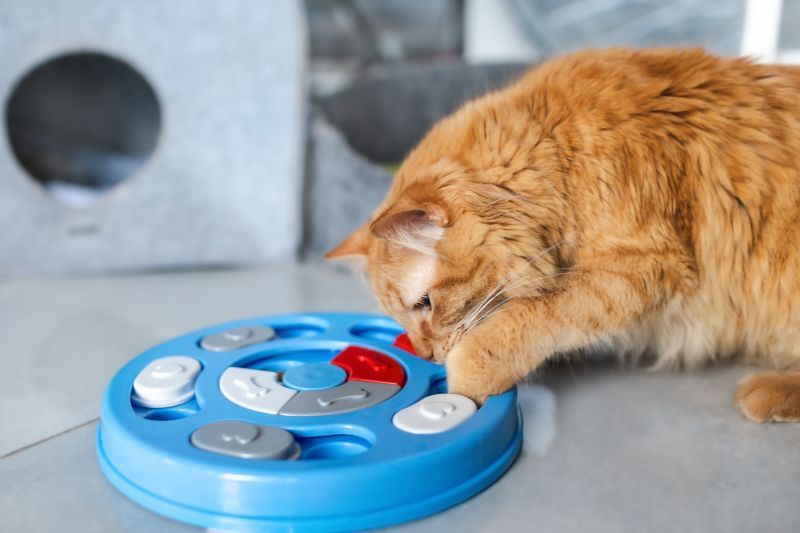
- Solve food puzzles and other problems. Individual cats vary greatly, but many learn how to manipulate puzzle feeders and other objects to obtain food.
Perhaps most importantly, a cat that does not respond to a test is not necessarily a cat that does not understand it. They may simply have decided that participating is not worth the effort.
Expert advice from Dr Felicia:
Be careful what you wish for… clever cats can be more demanding as pets/companions, just like dogs who are used to ‘working’ have higher maintenance and exercise requirements to be content in their companion role.
5 fun ways to explore your cat’s cleverness
There is no scientifically validated “cat IQ test” you can perform at home. However, you can try some simple games that explore different aspects of your cat’s learning, memory and problem-solving skills.
Keep the sessions short and enjoyable, use something your cat genuinely values as a reward and never force them to participate.
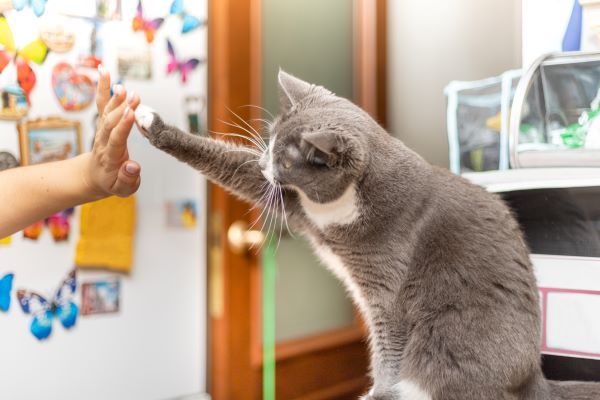
1. Teach them something new
Try teaching your cat a simple behaviour such as “sit”, “come”, touching your hand with their nose or giving you a paw.
Use a small food reward immediately after the behaviour you want.
Some cats learn very quickly, while others may need more repetition – and some may simply decide your proposed reward isn’t worth working for.
2. Try a hidden-toy game
Show your cat a favourite toy and then hide it behind a piece of furniture while they are watching.
Do they immediately look behind the furniture? Do they search somewhere else, or simply lose interest?
This can give you a glimpse of your cat’s memory and understanding of objects that disappear from view, but don’t treat the result as a score of intelligence. Motivation can dramatically affect how a cat responds.
3. Try the two-cup game
Place a favourite treat beneath one of two cups or small containers while your cat watches.
Give them the opportunity to choose.
You can make the game gradually harder by increasing the time between hiding the treat and allowing your cat to choose.
4. Give them a problem to solve
Place a treat inside an easy food puzzle or a safe container your cat can manipulate.
Observe how they approach the problem. Do they use their paws? Nose? Teeth? Do they try several different strategies?
Start easy. A puzzle that is too difficult can produce frustration rather than useful mental stimulation.
5. Try the pointing game
Place a treat or toy near one of two locations when your cat isn’t looking, then point clearly towards the correct one.
Can your cat use your gesture to find it?
Scientists have found that some cats can successfully follow human pointing cues, although individual performance varies.
The important thing with all these activities is to treat them as games rather than exams. A cat wandering away halfway through an experiment may be demonstrating independence rather than lack of intelligence.
Some surprisingly clever things cats understand
Research into feline cognition has produced some particularly interesting discoveries.
Cats know more about names than you might think
Cats can distinguish their own name from other words. Researchers have also found evidence that household cats learn the names of other cats they live with simply through everyday experience – without anyone deliberately teaching them.
In multi-person households, cats may even form associations between the names and faces of familiar people.
Did you know? Cats don’t just recognise their own names. Research suggests household cats can learn the names of feline companions simply by listening to everyday conversations, without deliberate training.
Cats recognise your voice
A cat may appear to ignore you when you call them, but that doesn’t necessarily mean they haven’t heard or recognised you.
In experiments where cats could not see the speaker, their ear and head movements showed that they could distinguish their owner’s voice from the voices of unfamiliar people.
Your cat may mentally keep track of where you are
One particularly intriguing study played an owner’s voice from different locations.
Cats appeared more surprised when the same owner’s voice unexpectedly moved from one location to another, suggesting they had been keeping track of the person’s likely position even though they could not see them.
Cats can learn sound–object associations surprisingly quickly
In a 2024 experiment, cats were exposed to combinations of spoken sounds and images. The researchers found evidence that the cats rapidly learned associations between the two.
This doesn’t mean cats understand language in the way humans do, but it adds to growing evidence that cats absorb more information from everyday human speech than their sometimes indifferent behaviour might suggest.
Did you know? A 2024 study found evidence that cats can rapidly form associations between spoken sounds and images after only brief exposure.
Can you make your cat smarter?
It is probably more accurate to talk about keeping your cat mentally stimulated than increasing their IQ.
Cats benefit from an environment that allows them to explore, play, hunt, climb, scratch, hide and solve problems.

Useful enrichment can include:
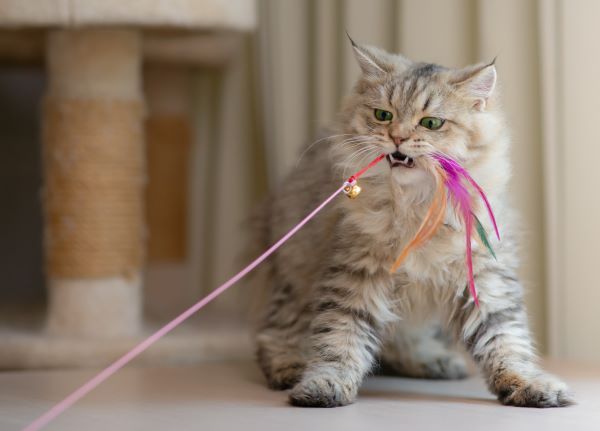
- interactive play with wand-style toys
- food puzzles
- hiding small amounts of food for your cat to find
- climbing structures and elevated resting places
- safe hiding places
- scratching surfaces
- rotating toys rather than leaving every toy available all the time
- short positive training sessions
- opportunities to safely explore new sights, smells and experiences.
Puzzle feeders can be particularly useful because they combine food with natural searching and problem-solving behaviours.
The aim isn’t to turn your cat into a feline Einstein. Mental stimulation helps provide opportunities to express normal behaviours and can contribute to overall welfare, regardless of how quickly your cat solves a particular puzzle.
Expert advice from Dr Felicia:
The great thing about providing a more stimulating environment for your cat is a boost in their general wellbeing, and cementing of the animal-human bond when you interact. Thankfully many of us may have cats that are more ‘beauty’ than ‘brains’, and that’s perfectly fine too.
New experiences and challenges help new neural connections form inside the cat’s brain. These and other mental challenges, when performed regularly, are great ways to stimulate your kitty and provide a boost to their intelligence.
Read our article Cat play and toys – it’s not just fun & games! for more ideas on keeping your cat physically and mentally active.
In conclusion
Cats may not perform jobs for humans or eagerly participate in laboratory experiments, but that shouldn’t be mistaken for lack of intelligence.
Research increasingly shows that cats pay close attention to their environment and to the humans around them. They can recognise familiar voices and names, follow some human gestures, learn associations and solve problems – although whether they choose to demonstrate those abilities on demand is another matter entirely.
Rather than trying to give your cat an IQ score, provide opportunities to play, explore, learn and solve problems. Whatever their level of feline genius, they’ll benefit from the stimulation.
Bow Wow Meow Pet Insurance can help protect you and your cat should an unexpected trip to the vet occur.
-
Find out more about our cat insurance options
-
Get an online pet insurance quote
Bow Wow Meow is proud to have been awarded winner of Canstar’s ‘Most Satisfied Customers’ Award in the Pet Insurance category for both 2024 and 2025!
Bow Wow Meow is proud to be the only Pet Insurer that has been awarded Product Review’s Top Rated Pet Insurance every year from 2018 to 2026! This is based on 3,193 independent customer reviews (as at 09/04/2026), with an overall rating of 4.5 stars.

We also have the following ratings on other review platforms:
Google Review rating of 4.5 stars (based on 1,358 reviews)
Trust Pilot rating of 4.6 stars (based on 555 reviews)
Bow Wow Meow Pet Insurance has been named by Finder as the Most Awarded Pet Insurance for 2021-26, after winning 4 categories in the 2026 Finder Pet Insurance Customer Satisfaction Awards!


– Most Trusted Pet Insurance
– Easiest to Claim Pet Insurance
– Most Recommended Pet Insurance
– Legendary Service Pet Insurance
We also received Highly Commended Awards for Loved Brand Pet Insurance and Best Value Pet Insurance.
Bow Wow Meow is an Australian-owned and operated pet insurance provider. Our focus is purely on pets, and we are proud to have helped provide peace of mind to over 200,000 Aussie pet owners since 2008.
Sources:
Vitale Shreve KR, Udell MAR. “What’s inside your cat’s head? A review of cat cognition research past, present and future”, Animal Cognition, 2015. https://pubmed.ncbi.nlm.nih.gov/26154131/. Accessed 19 November 2026.
Saito A, Shinozuka K, Ito Y, Hasegawa T. “Domestic cats (Felis catus) discriminate their names from other words”, Scientific Reports, 2019. https://pubmed.ncbi.nlm.nih.gov/30948740/. Accessed 19 November 2026.
Saito A, Shinozuka K. “Vocal recognition of owners by domestic cats (Felis catus)”, Animal Cognition, 2013. https://pubmed.ncbi.nlm.nih.gov/23525707/. Accessed 19 November 2026.
Takagi S, Saito A, Arahori M, et al. “Cats learn the names of their friend cats in their daily lives”, Scientific Reports, 2022. https://pubmed.ncbi.nlm.nih.gov/35418204/. Accessed 19 November 2026.
Takagi S, Koyasu H, Nagasawa M, et al. “Rapid formation of picture-word association in cats”, Scientific Reports, 2024. https://www.nature.com/articles/s41598-024-74006-2. Accessed 19 November 2026.
Ellis SLH, Rodan I, Carney HC, et al. “AAFP and ISFM Feline Environmental Needs Guidelines”, Journal of Feline Medicine and Surgery, 2013. https://pubmed.ncbi.nlm.nih.gov/23422366/. Accessed 19 November 2026.