Are Afghan Hounds good family dogs?


Afghan Hound
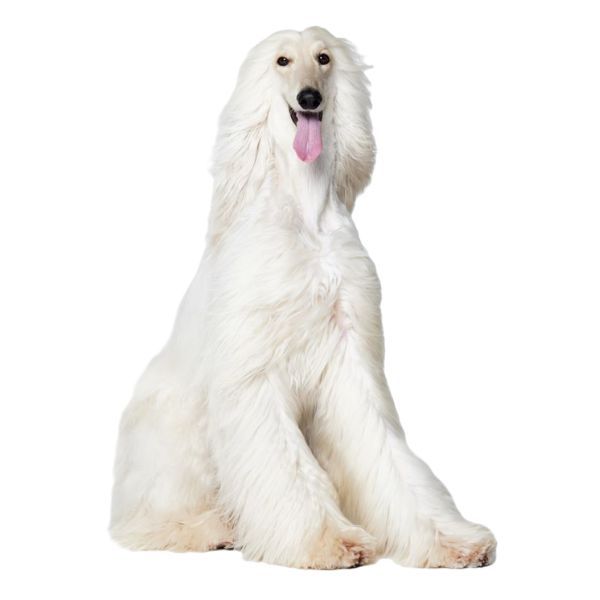
The Afghan Hound is an elegant, athletic sighthound known for its long, flowing coat, dignified appearance and independent nature. Originally bred to hunt across the rugged terrain of Afghanistan, this ancient breed combines speed and endurance with a sensitive, sometimes aloof personality.
| Recommended for | Experienced, patient, active singles, couples or families with older children |
| Breed Classification | Hound group, sighthounds |
| Other names | Afghan, Affie |
| Lifespan | 12 -18 years |
| Size | Large |
| Temperament | Dignified, independent, sensitive and aloof |
| Intelligence | Average: they are highly independent, so may understand commands without always choosing to follow them |
| Tendency to bark | Low to moderate: they tend to be quiet indoors but may bark to alert their owners or when bored, anxious or under-exercised |
| Maintenance Level | High: frequent grooming, regular exercise and patient, consistent training |
| Health Risk | Afghan Hounds are generally healthy but may be susceptible to hip dysplasia, cataracts and other eye disorders, and thyroid conditions. |
Thinking of insuring an Afghan Hound?
Explore the Top 5 health issues claimed for Afghan Hounds, including highest claims paid and how much pet insurance could help you save on eligible vet bills.
See Afghan Hound pet insurance Ready to get cover? Get a quick quote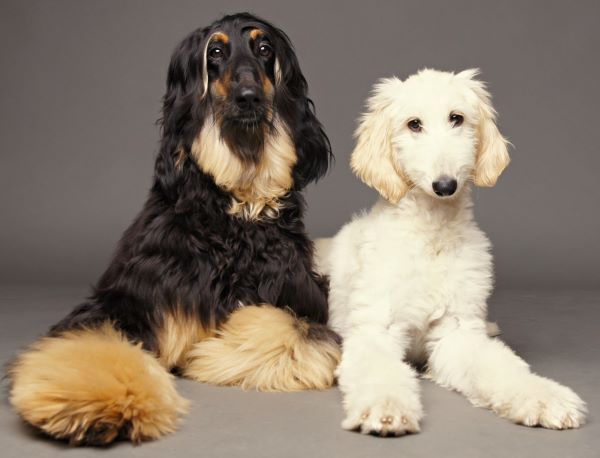
Afghan Hound personality and temperament
Afghan Hounds carry themselves with confidence, dignity and an unmistakably aristocratic air. Although often calm and composed at home, they also have a playful, endearingly silly side that may emerge around people they trust. Their independent nature means they are not always demonstrative or eager to please, but they can be deeply affectionate and loyal to their families.
Naturally reserved and aloof with unfamiliar people, Afghan Hounds may take time to warm to new visitors rather than immediately seeking attention. Early socialisation can help them become confident and well-adjusted, but their dignified, self-contained character generally remains part of the breed.
The Afghan Hound is not suited to every household. Prospective owners should be prepared for an intelligent, sensitive and strong-minded dog that requires patience, gentle training and an appreciation of its independent temperament.
Afghan Hounds with kids and other pets
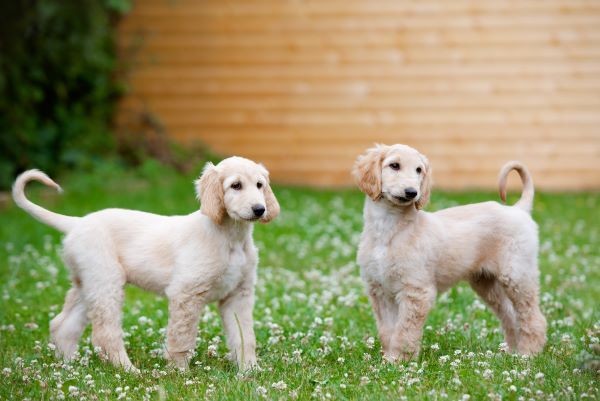
Afghan Hounds can make affectionate companions for respectful children, particularly when raised and socialised with them. They may enjoy games and playtime, although their independent temperament means they are not always highly interactive. Because they are large, sensitive dogs with long coats that young children may be tempted to grab, close supervision is essential, and children should be taught to treat them gently.
Afghan Hounds may live successfully with other dogs and pets, especially when introduced carefully from a young age, but compatibility varies between individuals. As sighthounds bred to pursue game, they retain a strong instinct to chase, so cats and smaller animals may trigger their prey drive. Introductions should be gradual, and Afghan Hounds should not be left unsupervised with small pets.
Afghan Hound training and exercise
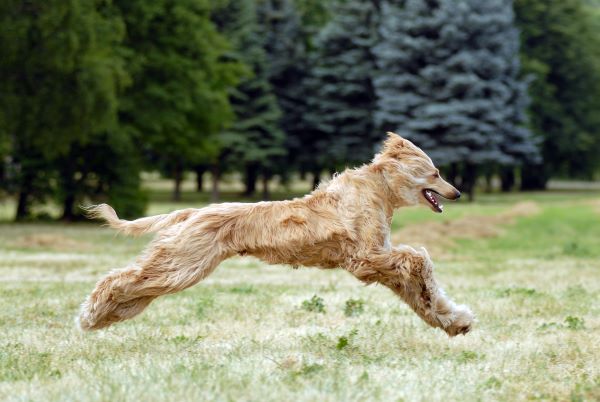
The Afghan Hound is an active, athletic breed with impressive speed and endurance. Daily walks are important, but many Afghans also benefit from regular opportunities to stretch their legs and run freely at their own pace. Exercise should be varied and appropriate for the dog’s age, fitness and health, with strenuous or forced exercise avoided while puppies are still growing.
Afghan Hounds often excel at activities such as lure coursing, which provide a safe outlet for their natural chasing instincts. Because they were bred to pursue game by sight, they may suddenly chase wildlife or other moving animals, so off-leash exercise should be limited to spacious, securely fenced areas. Their enclosure should be carefully checked for gaps and have fencing tall and secure enough to prevent escape.
Training and socialisation should begin early, using patient, consistent and reward-based methods. Afghan Hounds can learn basic commands, but their independent nature and strong prey drive can make recall unreliable when something catches their attention. Even a well-trained Afghan should therefore remain on a lead outside securely enclosed areas
The breed can also be quite aloof with strangers, so early socialisation is especially important for the Afghan. Their free spirit and independence can make them hard to train, so they are not recommended for novice dog owners.
| Energy level | Moderate to high, combining athletic bursts of speed with a calm nature at home |
| Exercise requirements | High: daily walks and regular opportunities to run safely in a large, securely fenced area |
Common health issues for Afghan Hounds
What do Afghan Hound owners claim for the most?
- Cataracts are an opacity or cloudiness in the lenses of the eye, which can be complete or partial. Dogs with more than 60 percent opacity in their lens can have partial blindness or complete loss of vision. Cataracts usually occur in both eyes, with the condition being more common in dogs than in any other species. Cataracts are progressive and if not treated, can result in blindness.
- Hip dysplasia and elbow dysplasia are inherited conditions which occur when the ball and socket of the affected joint do not fit together properly. As these conditions can cause painful arthritis in the joint later in the dog’s life, it is essential to begin management and/or treatment of the condition as soon as possible. For elbow dysplasia, surgery may be recommended.
- Dilated cardiomyopathy is commonly referred to as an enlarged heart in dogs. In this condition, the cardiac muscle walls progressively weaken and lose their ability to contract properly and pump blood efficiently. This leads to poor circulation and increased pressure in the heart and blood vessels, which causes the heart to stretch even more.
- Gastric torsion, also know as bloat, is a condition that affects large, deep-chested breeds like the Afghan Hound. A life-threatening stomach condition, it occurs when a gas-filled stomach flips over on itself, twisting the opening to the oesophaegus and intestines. Owners should learn the warning signs of GDV and seek immediate veterinary attention if it is suspected.
- Hypothyroidism, in which the thyroid gland does not produce enough thyroid hormone, is a growing issue among Akitas. Symptoms include weight gain and hair loss. Epilepsy can also be caused by hypothyroidism. Affected dogs can take daily oral medication to combat the condition.
- Progressive Retinal Atrophy (PRA) describes a group of conditions in which an atrophy or degeneration of retinal tissue occurs. The first sign of progressive retinal atrophy is usually night blindness; this progresses to total blindness over a period ranging from months to years.
- Sighthounds, including Afghans, are more sensitive to anesthesia than other breeds.
Not all conditions are covered by Pet Insurance. For details of Bow Wow Meow Pet Insurance cover, refer to the Product Disclosure Statement.
How to choose the right insurance for your Afghan Hound
When comparing cover for your Afghan Hound, look for:

Cover for common Afghan Hound conditions:
Check that the policy covers conditions Afghan Hounds can be prone to, including common health issues.

Cover for hereditary conditions:
No exclusions for hereditary or congenital conditions⑅.

Flexible cover options:
Options to adjust your annual benefit limit, reimbursement rate and excess.
Bow Wow Meow's Nose-to-Tail Cover offers flexible options for your Afghan Hound, with cover for accidental injuries, illnesses and hereditary conditions⑅. Get a quick quote for cover that suits your Afghan Hound and your budget.
Afghan Hound feeding and nutrition
The Afghan Hound should be fed a high-quality, complete and balanced dog food appropriate for its life stage, activity level and individual health needs. Portions should be measured and adjusted to maintain a healthy body condition, with treats included in the dog’s overall daily intake.
Afghan Hounds have naturally lean, athletic physiques, and the breed standard describes their hip bones as relatively prominent and widely spaced. However, visible hip bones should not automatically be assumed to be normal; weight, muscle condition and overall body condition should be assessed regularly, ideally with guidance from a veterinarian.
As a deep-chested breed, the Afghan Hound may be at risk of gastric dilatation-volvulus, a life-threatening emergency in which the stomach expands and may twist. Rather than feeding one large daily meal, divide the daily allowance into two or more smaller meals, discourage rapid eating and avoid vigorous exercise around mealtimes.
Afghan Hound care and grooming
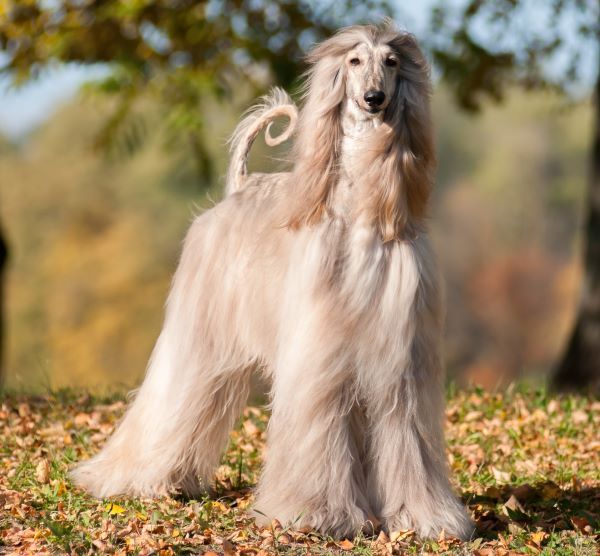
Afghan puppies have short, fuzzy coats that require little maintenance. They don’t stay that way for long, however.The adolescent and adult Afghan’s fine long hair requires lots of grooming, and brushing after each outing is recommended to ensure a silky smooth look.
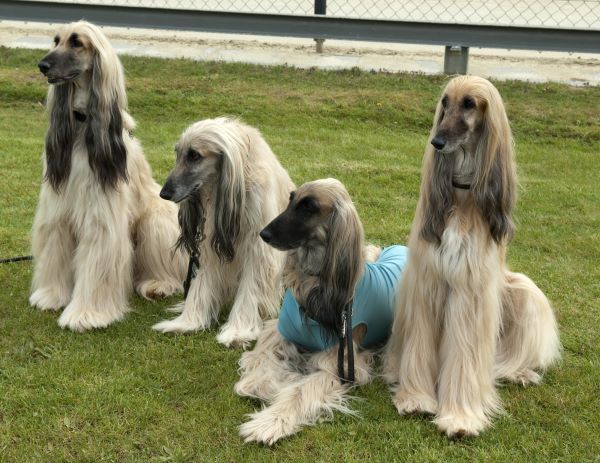
Several hours per week of brushing are needed to keep the hair free of tangles and mats, as well as to remove any debris. Keeping the hair clean and mat-free is the key to keeping the Afghan’s glorious coat looking its best. Regular bathing, with shampoo and conditioner is also required – ideally on a weekly basis, but at least fortnightly. The hair will need trimming, and while you may be able to do this yourself, it can be beneficial to have your Afghan visit a professional groomer every couple of months.
Size, appearance and coat of Afghan Hounds
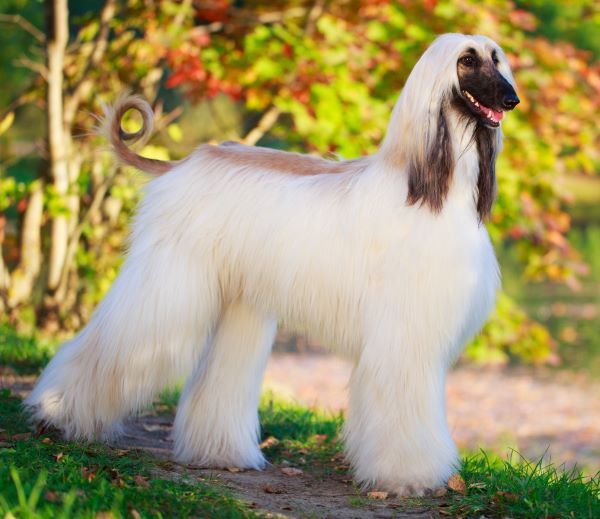
Among the most eye-catching of all dog breeds, the Afghan Hound is famous for its elegant, regal beauty. Large, long-legged and powerfully built to endure a long day’s hunt, they are also very fast and agile runners who can reach speeds of 45km per hour. Their huge paw-pads acted as shock absorbers on their homeland’s punishing terrain.
The long, fine, silky, flowing coat that the breed is famous for isn’t ‘just for show’; it served as protection from the harsh climate in mountainous regions where Afghans originated. Long and very fine on the legs, ribs, flanks and back from the forehead, it can be short and much coarser along the dog’s back. A long silky topknot is also a breed characteristic, and a hood of long hair may form from the top of the neck and flow into the shoulders and withers.
| Weight range | 26 to 34 kg |
| Height range | Males 68 to 74 cm; females 60 to 69 cm |
| Colours | All colours including black, cream, gold, red, blue, silver and brindle, as well as various colour combinations; some also have a dark facial mask. |
| Coat length | Long, with shorter hair on the face and a distinctive short-haired saddle developing along the back in adults |
Breed history of Afghan Hounds
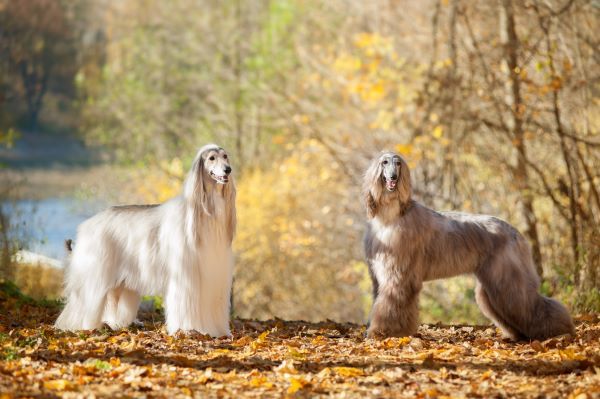
The Afghan Hound is often described as an ancient breed, although claims that it is the world’s oldest purebred dog or that it predates written history by thousands of years cannot be verified. Breeds did not exist in their modern, standardised form in antiquity. The Afghan Hound developed from long-haired sighthounds found across Afghanistan and neighbouring parts of Central and South Asia, but its precise ancestry and place of origin remain uncertain. The FCI officially lists Afghanistan as its country of origin and Great Britain as its country of patronage.
These swift, powerful hounds were traditionally used to pursue game across mountainous, desert and steppe terrain. Early documentation is scarce, but this should not be attributed to a complete Islamic prohibition on depicting animals; animal imagery appeared widely in secular Islamic art, although it was generally avoided in religious settings. An often-cited engraving published in Thomas Duer Broughton’s 1813 account of a Mahratta camp in India shows a soldier with a long-haired hound resembling an Afghan Hound, but it does not prove an unbroken line to the modern breed.
Afghan-type hounds began reaching Britain around the turn of the 20th century, often with military personnel returning from British India and surrounding regions. Zardin, imported in 1907, became an important early model for the breed standard, although his bloodline does not survive in modern pedigrees. Today’s Afghan Hounds descend mainly from the lighter-coated Bell-Murray dogs brought to Britain in 1920 and the more heavily coated Ghazni dogs brought from Kabul in 1925; the two lines were later combined to establish the modern breed.
Afghan Hound facts!
- Afghan Hounds belong to the subcategory of hound breeds known as sighthounds, dogs who rely on their panoramic vision and explosive speed to spot and pursue their prey.
- The giant sculpture by Pablo Picasso in Chicago’s Daley Plaza depicts Kabul, the artist’s much-loved Afghan Hound, and his 1962 painting “Femme au chien” features an Afghan Hound.
- A breeding pair were imported from England by Zeppo Marx, the youngest of the wacky Marx Brothers.
- The breed’s popularity soared when Mattel created a pet for Barbie – an Afghan Hound aptly called Beauty.
- Snuppy the Afghan Hound became the first cloned dog in 2005, which involved using skin cells from a 3-year old Afghan.
- An ancient myth says that a pair of Afghan Hounds represented the canine species on Noah’s Ark.
Summary
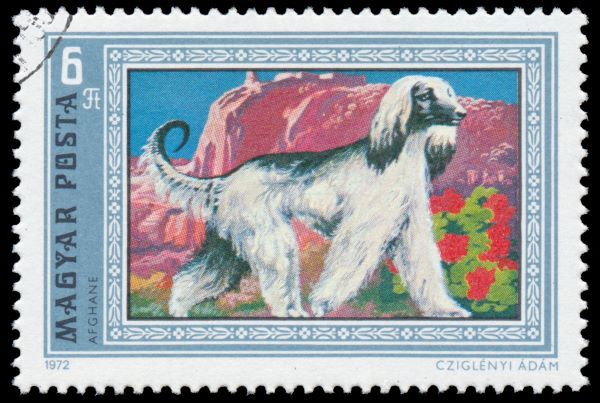
The Afghan Hound is an elegant, athletic sighthound known for its long, silky coat, dignified bearing and independent personality. Originally developed to hunt across the rugged terrain of Afghanistan and surrounding regions, the breed combines impressive speed and endurance with a calm, often aloof nature at home. Afghans are affectionate and loyal with people they trust, but they can be reserved with strangers and are not always eager to please.
This is a high-maintenance breed that needs extensive grooming, daily exercise and regular opportunities to run safely in a secure area. Patient, reward-based training and early socialisation are important, although their strong prey drive can make recall unreliable. Best suited to experienced and committed owners, the Afghan Hound can be a sensitive, graceful and devoted companion.
FAQs about the Afghan Hound
Afghan Hounds can be affectionate and loyal family companions, particularly in households that understand their sensitive and independent nature.
They can live happily with calm, respectful children, but interactions with young children should always be supervised because of the breed’s size and sensitivity.
They are generally better suited to experienced owners who can manage their extensive grooming, strong prey drive and independent approach to training.
Afghan Hounds need daily walks and regular opportunities to run in a spacious, securely fenced area.
Their strong chasing instinct can make recall unreliable, so they should only be allowed off lead in a securely enclosed area.
They are intelligent but independent and may not always be eager to follow commands. Patient, consistent and reward-based training works best.
Afghan Hounds are generally low to moderate barkers, although they may become vocal when alerting, bored or anxious.
Yes, Afghan Hounds shed, although their long coat may trap loose hairs rather than dropping them freely around the home.
Their long, silky coat requires brushing several times a week—often daily—to prevent tangles and mats, along with regular bathing and professional grooming.
Some can live successfully with other pets when raised and carefully socialised with them, but their strong prey drive may make them unsuitable around unfamiliar cats or smaller animals.

Get 2 months free for your puppy!
Congrats on your new bundle of joy
To ensure your precious fur baby is covered from the start, we'd like to offer your first 2 months of our Nose-to-Tail Cover for free2!
Get a quick quote