Intervertebral disc disease (IVDD) in dogs

Summary
IVDD occurs when disc material presses on the spinal cord, causing pain, weakness or paralysis. Small chondrodystrophic breeds are at higher risk. Vets diagnose with exam and imaging. Treatment ranges from strict rest and pain relief to surgery. Careful lifting, crate rest and physiotherapy support recovery. Seek urgent assessment for sudden weakness or loss of bladder control.
What is intervertebral disc disease or IVDD in dogs?
The intervertebral discs are circular pads of cushioning fibrocartilage situated between each vertebra of the spinal column. Each disc has a strong outer layer, called the annulus fibrosus, and a soft, jelly-like filling called the nucleus pulposus. These discs are important for the normal functioning of the spine; they protect the vertebrae as the spine’s shock-absorbing system for movements side to side and upwards.
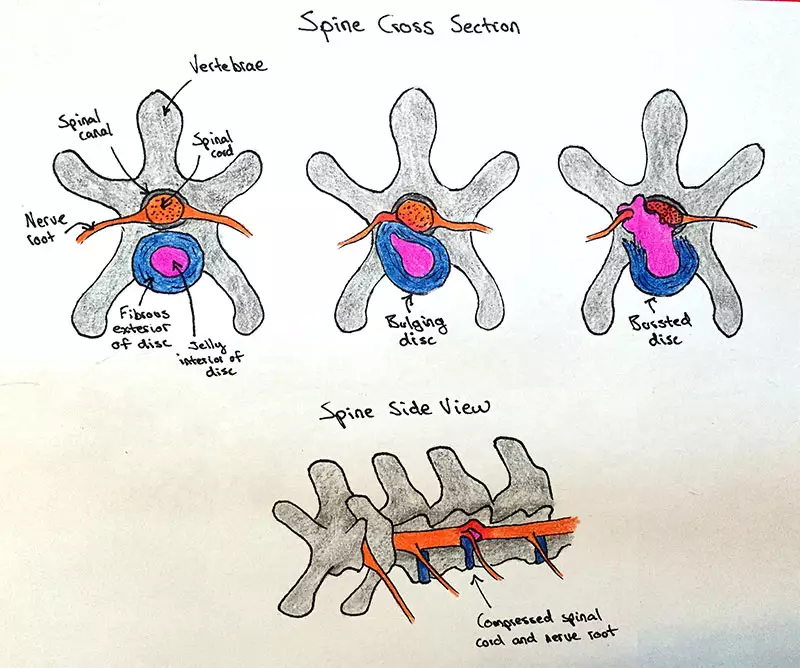
In dogs, when the intervertebral discs have degenerative changes or are diseased, discs can become displaced, deteriorated, collapsed, bulging or protruding, causing pain and neurological problems as they compress the spinal cord.
Expert advice from Dr Felicia:
While we usually think about dachshunds and other small breeds being the poster-children for IVDD, this can also affect other larger breeds through a slightly different disease process.
Herniated disc
A herniated disc, also known as a slipped or ruptured disc, occurs when the outer layer tears and the soft ‘jelly’ inside the disc pushes out through the tear. This causes compression of the nerves within the spinal cord, leading to pain, numbness and weakness.
An acutely herniated disc can be brought on in an otherwise normal dog by strenuous physical activity or acute physical trauma, such as jumping down from a high place, being hit by a car or attacked by another animal. However, more commonly disc problems suffered by dogs are from a degenerative disc disorder known as intervertebral disc disease (IVDD).

Intervertebral disc disease (IVDD)
Intervertebral disc disease (IVDD) is a condition where the discs between the vertebrae of the spinal cord degenerate, causing pain and neurological problems. With IVDD, the discs can bulge out (protrude) or herniate (burst) into the spinal cord space, causing compression of the spinal cord and nerves at the site. This results in pain, nerve damage and even paralysis.
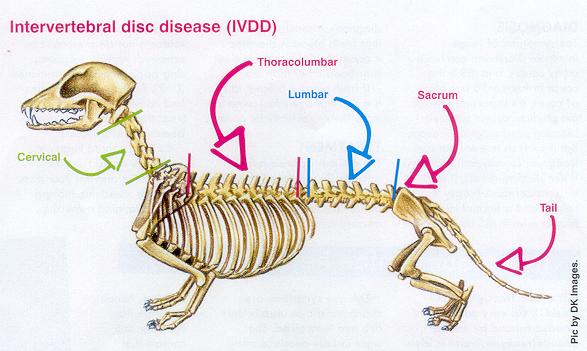
IVDD is a common neurological disorder in dogs, reportedly affecting 2% of domestic dogs. The most common sites of disc herniation are the cervical (neck) and thoracolumbar (upper back) regions.
There are two primary forms of Intervertebral Disc Disease that occur in dogs, known as Hansen Type I and Type II. These both involve degeneration of intervertebral discs, but the mechanisms of degeneration and the predisposed breeds differ.
Type I
Hansen Type I IVDD is an acute, progressive chondroid (cartilage) degeneration of the disc. Degeneration usually begins within the first few months of life. Multiple discs can be affected. Eventually, the outer disc layer ruptures acutely, allowing the calcified inner layer to extrude and press against the spinal cord, causing pressure, inflammation and nerve damage. Signs of disease are often seen acutely, with signs appearing between 3 and 6 years of age.
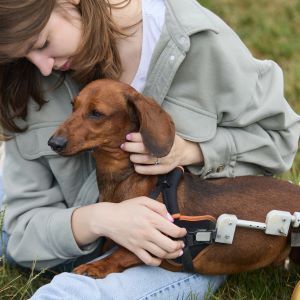
Breeds of dog that are most commonly affected by Hansen Type I IVDD include the Dachshund, Beagle, Basset Hound, Lhasa Apso, Pekingese and Shih Tzu, with Miniature Dachshunds having a lifetime prevalence of about 20%. These are known as the Chondrodystrophic breeds; they have abnormally short, stubby limbs and suffer from a hereditary disorder of cartilage formation (“chondrodystrophy” is a disorder of cartilage formation).
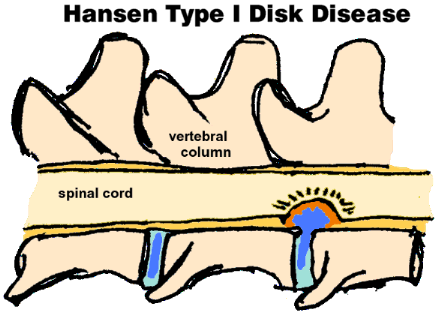
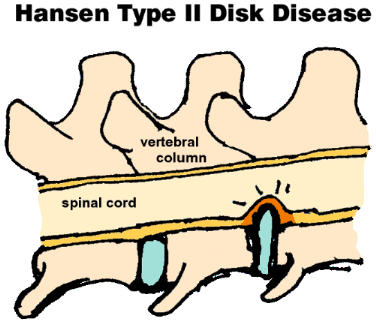
On the right the nucleus pulposus has herniated upward into the dorsal longitudinal ligament and spinal cord, creating swelling and inflammation. (Original graphic by marvistavet.com) Source
Type II
Hansen Type II IVDD involves a slower, more gradual degeneration that leads to chronic bulging and protrusion of inner disc material into the spinal canal, with subsequent pressure on and compression of the spinal cord. Type II comes on slowly, without the sudden, severe pain normally associated with Type I. Type II, like Type I can affect multiple disc spaces.
Type II usually affects older dogs between 8 and 10 years of age of non-chondrodystrophic breeds, such as German Shepherds, Labrador Retrievers and Doberman Pinschers. Obese dogs of predisposed breeds are especially likely to suffer from Type II IVDD.
Cost of intervertebral disc disease in dogs
Average claim costØ |
Highest claim costØ |
No of dogs affected in 2022Ø |
| $3,480 | $31,221 | 2,849 |
ØBased on PetSure claims data, 2022 calendar year. Reimbursement for these claims under a pet insurance policy would be subject to limits, such as annual benefit limits or sub-limits, benefit percentage, applicable waiting periods and any applicable excess. Cover is subject to the policy terms and conditions. You should consider the relevant Product Disclosure Statement or policy wording available from the relevant provider. Please note that values calculated are based on all claims for that condition and medically related conditions in each calendar year.
Because it is difficult to predict the costs of veterinary care, it can help to have measures in place to help prepare for the unexpected. Pet insurance can help by covering a portion of the eligible vet bill if the unexpected does happen.Find out more about our dog insurance options.
Symptoms of intervertebral disc disease in dogs
There is a wide range of symptoms of intervertebral disc disease in domestic dogs, varying from signs of mild neck or back pain to partial or complete paralysis. When the nerves of the spinal cord are compressed by the bulging or herniated disc, the nerve impulses can’t transmit their signals to their intended destination in the limbs, bladder, etc. If nerve compression is severe enough, paralysis and loss of bladder and bowel control can occur. Depending on the location of the disc that is bulging, signs occur anywhere in the body from the neck to the rear legs.

Owners of affected dogs may notice one or more of the following symptoms, which can be sudden, intermittent or gradual in onset (while these symptoms are typical of IVDD in dogs, similar symptoms may occur after a healthy dog has engaged in strenuous physical activity or experienced acute physical trauma, causing an acute disc rupture):
- Neck pain and stiffness (reluctance to move the neck and head)) – this can be from side to side or up and down
- Muscle spasms in the neck or back
- Lowered head stance
- Back pain and stiffness
- Yelping unexpectedly when touched or moving
- Crying out in pain
- Abdominal tenderness or tenseness
- Arched back or neck (hunched posture)
- Sensitivity to touch (possible aggression)
- Sensitivity to movement
- Impaired, incomplete or inappropriate urination
- Lameness of forelimbs
- Dragging one or more legs when walking
- “Toeing over” or “knuckling over” when walking or standing
- Weakness of the limbs
- Stiffness
- Stilted gait; tentative gait
- Reluctance to shake, rise, move or jump
- Tremors, trembling, shaking
- Lack of coordination (“ataxia”)
- Abnormal reflexes
- Incontinence (urinary and/or faecal)
- Collapse
- Paralysis in one or more limbs
Expert advice from Dr Felicia:
Not every dog that comes into the vet clinic with a sore back with have intervertebral disc disease. However frequent episodes of back pain as well as any progression or neurological change in the function of the limbs are potential flags for underlying disc disease, and may warrant some further investigation.
Causes of an intervertebral disc disorder in dogs
Acute rupture
An acutely ruptured (herniated) disc can be caused in an otherwise healthy dog (i.e. one not affected by IVDD) by activities such as:
- Jumping off high places, out of a car or off the back of a truck, or even off the bed
- Playing a game of fetch or Frisbee
- Leaping out of an owner’s arms
- Being hit by a car, attacked by another animal or some other form of trauma
A sudden trauma can also cause rupture or herniation of an intervertebral disc in a dog whose discs already are weakened by IVDD.
Degenerative rupture
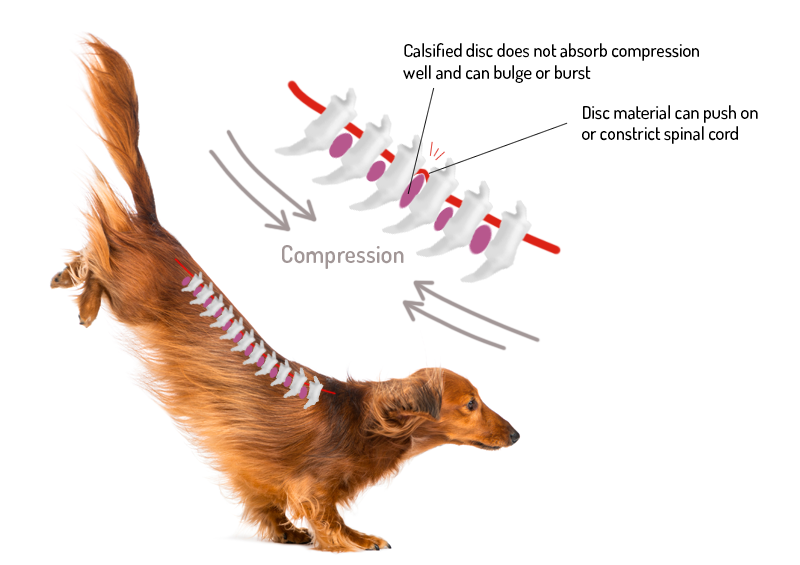
IVDD occurs more commonly in certain breeds but can occur in any breed or mix of breeds and in dogs of any age or gender. Both types of IVDD in dogs involve degeneration of intervertebral discs, although there are differences in the process of degeneration and the breeds affected.
Unsure how serious it is?
Bow Wow Meow policyholders can get access to trusted vet care anytime, anywhere, at no additional cost. Connect to an experienced Australian registered vet via video call, 24/7. Whether it’s providing vet advice, setting up at-home treatment plans, or confirming if you need to visit a vet in person, you can get help when you need it.
Find out more about our pet insurance cover options.
Type I:
- An acute and severe chondroid degeneration of the discs, where the outer layer of the disc hardens and calcifies, allowing it to break more easily.
- Can occur simultaneously in multiple discs along the vertebral column.
- Degeneration begins within the first few months of life, with disc protrusion occurring as early as 1 to 2 years of age, and the disease well advanced by 2 years of age.
- Clinical signs are acute and severe.
- Any forceful impact such as jumping can cause one or more damaged discs to rupture.
- Typically affects chondrodystrophic breeds with hereditary skeletal abnormalities in the smaller breeds, such as Dachshunds, Shih Tzus, Beagles, Pekingese, Poodles, Corgies and Bassett Hounds.
- Miniature Dachshunds have a lifetime prevalence of approximately 20%.
Type II:
- A gradual, chronic fibroid degeneration of the disc, where the disc becomes hardened and fibrous over time and eventually breaks down and bulges into the spinal column.
- Usually occurs in isolated discs along the length of the vertebral column.
- Occurs in middle-aged dogs usually older than 5 years.
- Clinical signs are slowly progressive.
- The disc eventually breaks down,bulging out and protruding into spinal canal causing compression.
- Conformational abnormalities, obesity, genetics and repetitive trauma can all play a role in gradual disc degeneration.
- Typically affects larger, non-chondrodystrophic breeds such as German Shepherds, Labrador Retrievers and Doberman Pinschers.
Excess weight is a predisposing factor
Being overweight can predispose our dogs to a variety of serious diseases including intervertebral disk disease. While ensuring our pets aren’t overweight doesn’t guarantee they won’t get ill, it’s something that you can control at home that can lead to a happier, healthier, and longer life for your dog.
Expert advice from Dr Felicia:
Given the hereditary component of this disease it is so important especially in predisposed breeds to actively manage their weight, and consider forms of exercise that are less likely to exacerbate or put strain on the spine.
How is intervertebral disc disease in dogs diagnosed?
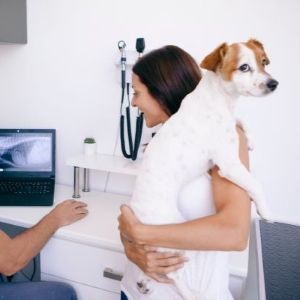
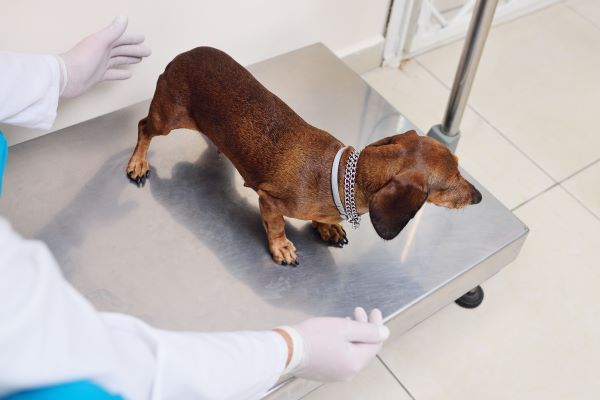
The diagnostic process for dogs with neurological spinal injuries can be quite involved and may require the involvement of several different veterinary specialists. Diagnosis is typically made based on assessment of the dog’s clinical signs, a thorough history, complete physical and neurological examination and imaging studies.
Physical examination
The veterinarian will perform a physical examination, including a neurologic evaluation, to determine the severity of nerve damage caused by the bulging disc and its location along the spinal column. Based on the neurological exam, which includes observing your dog’s moment and response to some reflex tests, the likely location of the lesion can be determined. If the dog is exhibiting severe symptoms such as inability to move the limbs or a high level of pain, a consultation with a neurologist or surgeon may be recommended for more extensive testing and possibly surgery.
Imaging studies
Definitive diagnosis of disc extrusion is based on imaging studies including radiographs, contrast spinal studies, CT scan and MRI study.
Radiographs (x-rays) of the spine are usually recommended and are typically performed under anaesthesia or heavy sedation. Radiographs can reveal abnormalities in the vertebrae and the spaces between them, such as bone tumours, fractures, discospondylitis (infection of the intervertebral disc space) or other possible causes of spinal cord damage, to exclude IVDD as the cause. Radiographs can also show narrowing of the affected disc space that is consistent with, but not diagnostic of, IVDD. However, radiographs are not sensitive or specific enough for definitive diagnosis of IVDD, which requires myelography, MRI, or CT.
Myelography is a form of medical imaging that is useful for dogs with suspected spinal column damage. Under anaesthesia, a contrast dye is injected into the spinal canal, after which x-rays are taken to identify the location of the herniated disc and the extent of spinal cord compression it is causing.
Other imaging techniques, such as an MRI (magnetic resonance imaging) or CT (computerised tomography) scan, can be helpful in identifying IVDD and locating the affected discs, which is necessary for surgical repair. However, these procedures are generally not available at general veterinary practices, and a visit to a referral/specialist practice may be required.
Expert advice from Dr Felicia:
Full workup including advanced imaging for patients with IVDD can be cost-prohibitive, but is important for treatment and prognosis. Typically full work-up is performed with a view to potentially progressing to spinal surgery, which is a specialist procedure. Without advanced imaging, the conservative treatment pathway is usually taken and typically has a poorer prognosis for dogs that are severely affected.
Prognosis
Prognosis is closely linked to pain perception, which is determined during the physical examination. Dogs with intact pain perception have an excellent prognosis particularly where disease is diagnosed and treated early in its course.
Less severe disease can be managed conservatively with strict cage rest for 3-4 weeks combined with pain relief using non-steroidal anti-inflammatory drugs and potentially opioids and muscle relaxants. However, the symptoms of IVVD in dogs treated conservatively have a recurrence rate that approaches 50%, especially if they are not strictly confined to cage rest and if they are obese.
Because it is difficult to predict the costs of veterinary care, it can help to have measures in place to help prepare for the unexpected. Pet insurance can help by covering a portion of the eligible vet bill if the unexpected does happen.
Get a quick quote
Dogs that have more severe signs of disease (for example, without deep pain sensation or recumbent) should be considered surgical candidates. Paraplegic dogs treated with pain perception treated surgically have a recovery rate of 93% compared with 56% of dogs treated conservatively.
If spinal cord compression is severe and the dog loses the ability to feel deep pain, the prognosis for recovery is more guarded, with 61% recovery in paraplegic dogs treated with surgery compared to 22% in dogs managed conservatively.
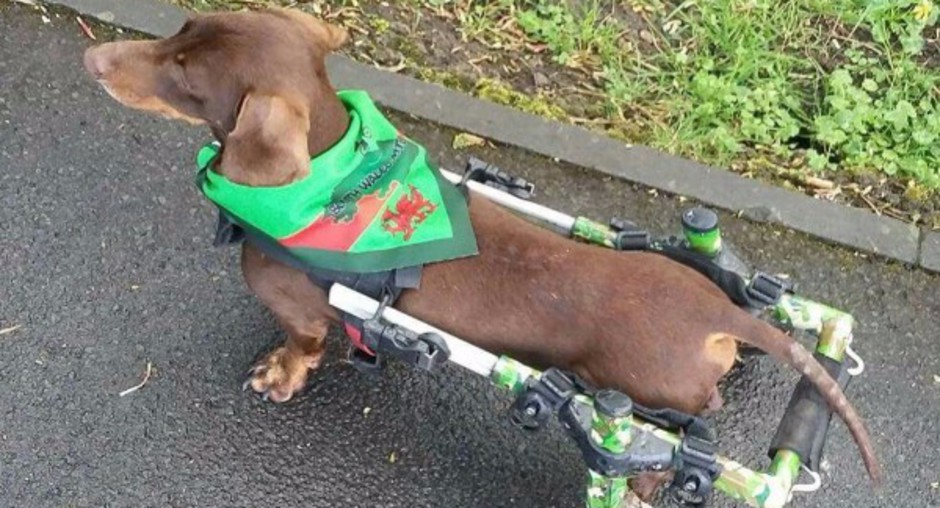
Rehabilitation post-surgery is important to help dogs regain function and speed up recovery. Dogs that do not have any return of pain perception 2-4 weeks from the time of surgery have a poor prognosis. However, the quality of life for these animals can be good if given proper nursing care. Some dogs require a special mobility cart to be mobile and active again.
Irrespective of whether they are treated surgically or conservatively, dogs may have subsequent bouts with IVDD if other discs herniate later in life.
Treatment for intervertebral disc disease in dogs
Treatment options range from rest and conservative medical management to surgical intervention. The treatment protocol will depend upon the severity of the disease, and financial constraints may also affect the treatment course that is pursued. In acute cases, pain management and control of inflammation are the first priorities.
Dogs showing only mild signs may be treated conservatively and monitored closely for signs of neurologic deterioration. Medical management (conservative therapy) will typically consist of:
- Strict cage rest for several weeks or more, because activity may lead to further disc extrusion and worsening of spinal cord compression.
- Medications to help manage pain and reduce swelling and inflammation caused by the bulging disc, which may include corticosteroids or nonsteroidal anti-inflammatory medications (but not simultaneously), muscle relaxants, opioids or other pain medication.
Dogs with pain and minimal to moderate neurologic deficits often recover with 2 to 3 weeks of cage rest. Clinical signs recur after conservative therapy in 30%–40% of cases.
Surgery for IVDD treatment
Surgery may be recommended in the following cases:
- The dog exhibits severe neurologic deficits, has lost deep pain sensation or has trouble walking.
- Poor response or non-response to medical management, with the dog’s condition deteriorating or not improving, and recurring episodes.
- The results of imaging (x-rays or other scans) suggest that surgery is necessary or appropriate.
Hemilaminectomy, a spinal surgery whereby the protruding section of the vertebrae is removed, is the most common procedure. Surgery aims to decompress the spine at the site of the affected disc.
Because it is difficult to predict the costs of veterinary care, it can help to have measures in place to help prepare for the unexpected. Pet insurance can help by covering a portion of the eligible vet bill if the unexpected does happen.
Get a quick quote
Ongoing care and management for IVDD
After the dog has been stabilised, whether by conservative management or surgery, and pain and neurological symptoms are under control, the following ongoing management strategies are essential for successful recovery:
- Strictly enforced cage confinement for up to 6 weeks, as recommended by the vet (and even if the dog appears fully recovered, as medication may be masking the symptoms).
- Weight loss program for overweight dogs, to reduce stress on the spine.
- Well-padded beds and to be turned every few hours, to prevent pressure sores.
- A gradual reduction in medications over time.
- Monitoring of bladder and bowel function.
- Minimal exercise and only as per the vet’s advice, for example, swimming or walking on-leash only, with a harness instead of a neck collar to keep pressure off the neck.
- Physical therapy, for example hydrotherapy, massage therapy, acupuncture and heat treatment.
- A gradual return to normal activity.
- No high impact activities such as uncontrolled running or jumping off high places, particularly for Chondrodystrophoid breeds; use steps or ramps to access furniture, beds or cars.
Expert advice from Dr Felicia:
Whether conservative or surgically managed, IVDD patients require a lot of nursing care and support in their recovery period.
In conclusion
Intervertebral disc disease is a condition where the cushioning discs between the vertebrae of the spinal column rupture (herniate) into the spinal column. The herniated discs then press on the nerves running through the spinal cord causing pain, nerve damage, and even paralysis. This can transpire from an acute trauma or a degenerative disease known as intervertebral disc disease (IVDD). Two primary forms of IVDD occur in dogs, called Hansen Types I and II intervertebral disc disease. Type I typically occurs in middle-aged chondrodystrophic breeds, with the Miniature Dachshund being particularly predisposed. Type II is more common in older-aged larger breeds.

The symptoms of intervertebral disc disease can be quite variable. The predominant signs are neck or back pain, which manifest as stiffness and muscle spasms, but may be as severe as inability to use the hind limbs. Regardless of the form of disc disorder, prompt treatment is needed to prevent further damage. Examination by the veterinarian will include a neurologic exam and imaging techniques, which will help identify where in the spinal cord the injury is located.
The prognosis for dogs with IVDD is generally quite good, however, the disease can lead to permanent nerve damage. Treatment options include conservative management and surgery. IVDD cannot be prevented, although there are some strategies to decrease risk, such as limiting high-impact activities.
Bow Wow Meow Pet Insurance can help protect you and your dog should an unexpected trip to the vet occur.
-
Find out more about our dog insurance options
-
Get an online pet insurance quote
Bow Wow Meow is proud to have been awarded winner of Canstar’s ‘Most Satisfied Customers’ Award in the Pet Insurance category for both 2024 and 2025!
Bow Wow Meow is proud to be the only Pet Insurer that has been awarded Product Review’s Top Rated Pet Insurance every year from 2018 to 2026! This is based on 3,193 independent customer reviews (as at 09/04/2026), with an overall rating of 4.5 stars.

We also have the following ratings on other review platforms:
Google Review rating of 4.5 stars (based on 1,358 reviews)
Trust Pilot rating of 4.6 stars (based on 555 reviews)
Bow Wow Meow has been chosen as Winner of 4 categories in the 2026 Finder Pet Insurance Customer Satisfaction Awards!




– Most Trusted Pet Insurance
– Easiest to Claim Pet Insurance
– Most Recommended Pet Insurance
– Legendary Service Pet Insurance
We also received Highly Commended Awards for Loved Brand Pet Insurance and Best Value Pet Insurance.
Bow Wow Meow is an Australian-owned and operated pet insurance provider. Our focus is purely on pets, and we are proud to have helped provide peace of mind to over 200,000 Aussie pet owners since 2008.